
Cloud kitchen, ghost kitchen, and virtual kitchen in Dubai: three names for one powerful business model
understanding the difference and similarities between cloud Kitchen, Ghost kitchen and Virtual kitchen
If you have been researching the food and beverage industry in Dubai, you have almost certainly come across three terms used interchangeably, sometimes in the same article, sometimes even in the same sentence: cloud kitchen, ghost kitchen, and virtual kitchen.
It is easy to assume these are three distinct business models but they are not.
As different people use various wording to describe the same concept, it is easy to become confused and misunderstand the meaning.
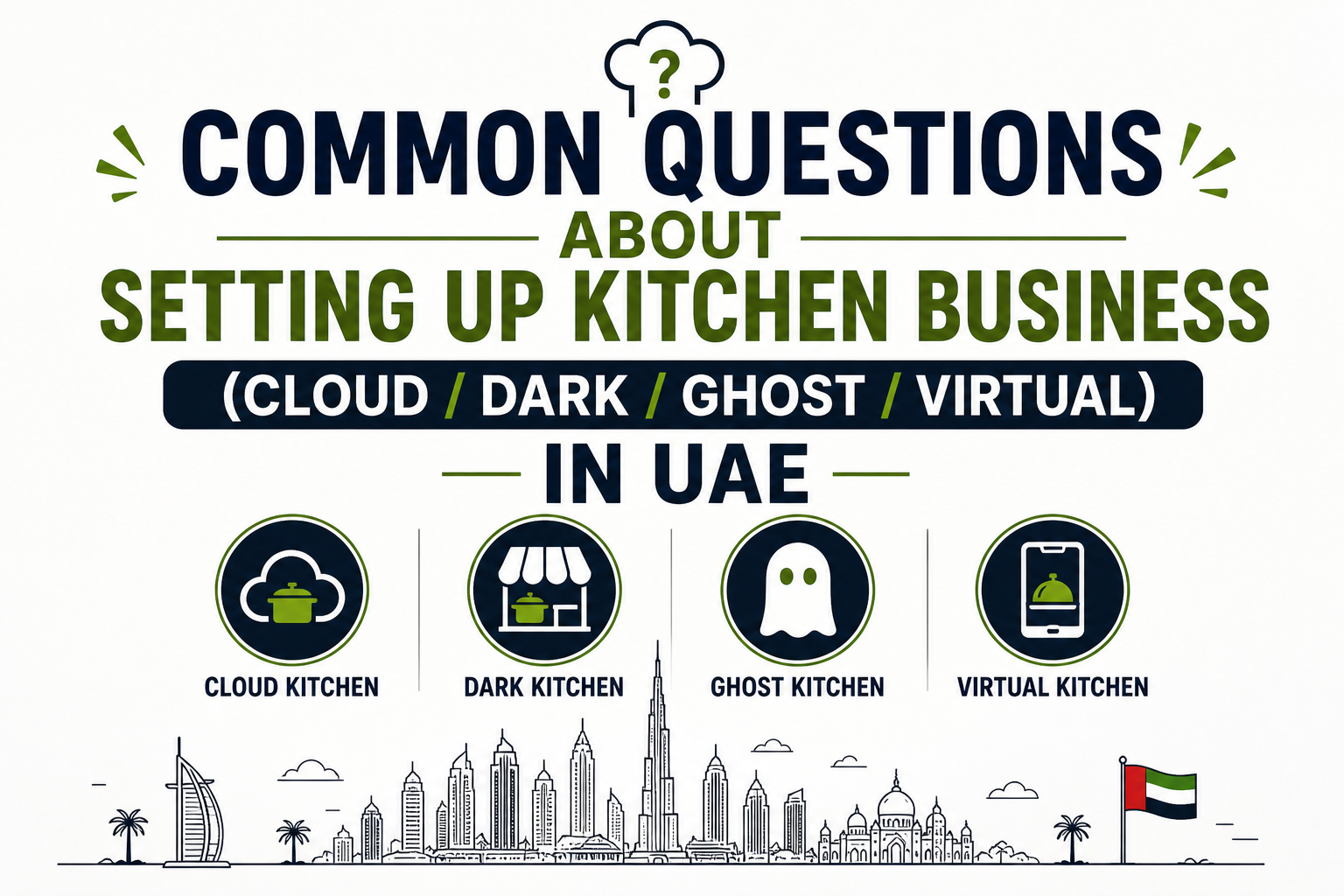
- Cloud kitchen, Ghost kitchen, and Virtual kitchen all refer to exactly the same thing: a professional, licensed commercial kitchen that prepares food exclusively for delivery, with no dine-in space, no physical storefront, and no walk-in customers.
The only real difference is the name, this depends on who is talking — the technology industry tends to say “cloud kitchen,” the media tends to say “ghost kitchen,” and operators focused on brand flexibility tend to say “virtual kitchen.”
- The underlying business model is identical.
- In most cases, you are required to bring your own staff. However certain kitchen operators have in house staff that you can hire and prepare food on behalf of your brand, as well as other restaurants.
This guide explains what that business model actually is, why it has transformed Dubai’s food scene, what makes it work, and why — regardless of what you call it — it represents one of the most significant shifts in the restaurant industry in a generation.
With the correct business and marketing strategy, this concept can be highly lucrative and rewarding.
Table of contents
- Defining the concept — what is a delivery-only kitchen?
- Why there are three different names?
- The similarities — why they are essentially the same thing
- How it works in practice
- Cloud kitchens in Dubai — the local landscape
- Why Dubai is one of the world’s best markets for this model
- Who uses cloud kitchens in Dubai?
- Key benefits of the model
- Challenges to be aware of
- Starting a cloud kitchen in Dubai — what you need to know
- Frequently asked questions about starting a virtual ghost kitchen in Dubai, Abu Dhabi, Sharjah, Al Ain, Ajman, Ras Al Khaimah, Umm Al Quwain, Fujairah.
- Summary
Defining the concept — what is a delivery-only kitchen?
At its core, a cloud kitchen — ghost kitchen — virtual kitchen is a licensed commercial food preparation facility that operates exclusively for delivery orders.
- There is no restaurant floor, tables, chairs, or waiting staff.
- There is no signage on the street inviting customers to walk in.
- There may not even be a publicly visible address.
In almost all circumstances, customers discover the brand through a food delivery platform — Talabat, Deliveroo, Noon Food, Careem, or similar — place an order through the app, and a driver collects the food from the kitchen and delivers it to their door.
The customer may never know — or care — that the “restaurant” they ordered from is one of ten brands operating out of a single industrial kitchen unit.
This is the defining characteristic of the model, regardless of which name you use for it:
- Brand exists digitally — the restaurant brand lives on an app, a website, and social media, not on a physical storefront
- Delivery only — all orders fulfilled through third-party delivery platforms or proprietary apps
- Location is secondary — the kitchen’s address is operationally important but commercially invisible to customers
- Lower overheads — no rent premium for a customer-facing location, no front-of-house staffing costs, no interior design expenditure
- No front-of-house — no dining room, no reception, no customer-facing space
Why is the same concept called different names?
The similarities — why they are essentially the same thing
Whether an operator, investor, or regulator in Dubai calls the facility a cloud kitchen, ghost kitchen, or virtual kitchen, the following characteristics are universally shared across all three names:
1. No dine-in service
All three models — cloud, ghost, and virtual kitchen — share the absolute defining characteristic of having no dine-in capability.
- Customers cannot visit as there is no table service, no walk-in counter, no drive-through.
The entire customer interaction happens through a digital interface before the food is prepared, and through a delivery driver after it is ready – this is true whether you call the kitchen a cloud kitchen, ghost kitchen, or virtual kitchen.
2. Delivery platform dependency
All three models rely heavily on third-party food delivery platforms — Talabat, Deliveroo, Careem, Noon Food — or proprietary delivery apps to reach customers and fulfil orders.
- Almost all operate using their own delivery driver – Ford aims that do have their own logistics team, they are able to cut down the cost of utilizing the platform by approximately 66%, from 30-35% commission charged to roughly 10-15% per order.
The delivery platform is the shop window, the marketing channel, and the order management system simultaneously.
- Without delivery platforms, it is more than probable that none of these kitchen models would exist in their current form.
3. Digitally native brand identity
The brand associated with a cloud, ghost, or virtual kitchen exists primarily in digital space.
- It is discovered through app store searches and delivery platform browsing. It is reviewed on Google, Zomato, and TripAdvisor.
- It is marketed through Instagram, TikTok, and targeted digital advertising.
The physical address of the kitchen is entirely irrelevant to the customer experience — what matters is the brand’s digital presence, its menu photography, its ratings, and its delivery speed.
4. Reduced capital expenditure
Because there is no customer-facing space to design, build out, or maintain, all three kitchen types share dramatically lower startup costs compared to a traditional restaurant.
- In Dubai, where premium retail locations in areas like Downtown, DIFC, JBR, or Dubai Mall command extremely high rents, the cost saving of eliminating front-of-house entirely is enormous.
- A traditional restaurant in a prime Dubai location might require an investment of AED 500,000 to AED 2,000,000 or more in fit-out, furniture, and equipment, before even factoring in rent, salary, operating expenses, marketing and other similar factors.
Location is the key, a cloud kitchen setup in a carefully selected area can be operational for a fraction of that cost.
5. Multiple brands from one kitchen
One of the most powerful features of the model — shared across cloud, ghost, and virtual kitchen frameworks — is the ability to operate multiple distinct restaurant brands from a single kitchen.
- The owner of one brand in Dubai might simultaneously serve orders for an American burger brand, a Japanese ramen concept, a healthy bowl concept, and a late-night dessert brand — all appearing as separate restaurants on Talabat, all prepared by the same kitchen team, and all fulfilling orders concurrently.
This multi-brand capability is fundamental to the economics of the model and is present regardless of which name the operator uses.
6. Licensing and regulatory framework is identical
In Dubai, the regulatory and licensing framework that governs cloud kitchens, ghost kitchens, and virtual kitchens is the same, because the authorities correctly treat them as the same type of operation.
- The Dubai Municipality’s Food Safety Department, the Department of Economic Development (DED), and where applicable the relevant free zone authority all issue licenses and regulate these facilities under a unified framework for food preparation establishments.
The name you use to describe your kitchen to regulators does not change the licence you need or the food safety standards you must meet.
7. Operational model and staffing structure
The operational structure of a cloud, ghost, or virtual kitchen is identical.
- There is a head chef or kitchen manager, a kitchen team responsible for food preparation, a station layout optimized for speed and delivery packaging, and an order management system — usually a tablet linked to the delivery platform — that receives and tracks incoming orders.
There is no front-of-house manager, no maître d’, no sommelier, and no waiting staff. The entire team is kitchen-facing.
8. Growth model — scalability
All three kitchen types share the same fundamental scalability advantage.
Because the brand exists digitally and the kitchen is a relatively standardised production unit, expanding to new locations — or new cities, or new countries — does not require the same complex site-by-site build-out that a traditional restaurant chain requires.
- A successful brand can be replicated in a new kitchen in a new location relatively quickly, which is why cloud kitchen networks in Dubai and globally have been able to scale so rapidly.
How it works in practice
Understanding the day-to-day operation of a cloud — ghost — virtual kitchen removes any remaining ambiguity about what these facilities actually do, and how they generate revenue.
The kitchen facility
The physical kitchen is a fully equipped, licensed commercial food preparation space, typically located in an industrial or light commercial area where rents are significantly lower than retail zones.
- In Dubai, areas such as Al Quoz, Ras Al Khor, Nad Al Hamar, and Dubai Investment Park are popular locations for cloud kitchen facilities.
The kitchen contains commercial-grade cooking equipment, refrigeration, storage, and preparation surfaces — identical in specification to the kitchen of a full-service restaurant.
Depending on the kitchen operator, there may be kitchenware already available or the brand needs to bring their own.
The brand and menu
One or more food brands operate from the kitchen, each with its own distinct identity, menu, packaging, and digital presence on delivery platforms.
The brand has been designed specifically for the delivery context — menus are typically tighter and more focused than dine-in restaurants, ingredients are selected to travel well, and packaging is designed to maintain food quality during delivery.
- Depending on what is allowed by the kitchen operator, they may or may not allow more than one brand (two different companies with separate owners) to operate from the same kitchen space.
The order flow
- A customer opens Talabat or their favourite food delivery platform, searches for their desired item, finds the brand, selects items, and places an order.
- The order appears instantly on a screen in the kitchen and the kitchen team begins preparation.
- When the food is ready — typically within 15 to 25 minutes — it is packaged, labelled, and placed in a collection area.
- A delivery driver — employed by the platform or by a third-party logistics provider — collects the order and delivers it to the customer.
- The customer rates the experience on the app.
- The cycle repeats, hundreds of times per day across all active brands.
Revenue and settlement
The delivery platform collects payment from the customer and remits to the kitchen operator, less a commission — typically between 15% and 30% of the order value depending on the platform and the operator’s agreement.
The kitchen operator manages food costs, labour, packaging, and kitchen rent from the remaining margin.
Operators running multiple brands from a single kitchen spread fixed costs across a larger revenue base, improving overall unit economics.
Why there are three different names for the same thing
The multiplicity of names is a product of the concept emerging simultaneously from different industries and being described by different communities with different vocabularies.
Understanding where each term came from explains why they are all used to describe the same underlying reality.
1) Ghost kitchen — the original term
The term ghost kitchen originated in the United States, coined in the early 2010s as the delivery-only restaurant model began to emerge.
The “ghost” referred to the invisible, spectral nature of the kitchen — a restaurant that existed, that you could order from, but that had no physical presence you could visit.
Ghost kitchen was the term popularised by media coverage, particularly in the US, and it remains the dominant term in North American markets and international press coverage.
In Dubai and the wider Middle East, “ghost kitchen” is widely understood and used, particularly in business and investment conversations.
2) Cloud kitchen — the tech industry’s term
The term cloud kitchen emerged from the technology and venture capital world, which drew an analogy between delivery-only kitchens and cloud computing.
Just as cloud computing moved infrastructure off-premise and made it accessible remotely, a cloud kitchen moves the restaurant off the high street and makes it accessible digitally.
- The “cloud” framing emphasised the scalability, the digital-first nature, and the technology infrastructure underpinning the model.
“Cloud kitchen” became the preferred term among technology companies, food-tech investors, and operators building large-scale, multi-brand kitchen networks.
- In Dubai, “cloud kitchen” is arguably the most commonly used term in business and licensing contexts, and is the term most often used by the operators of large kitchen facilities.
3) Virtual kitchen — the brand-focused term
The term virtual kitchen tends to be used by established restaurant operators who create delivery-only brands that run alongside — or instead of — their physical restaurants.
- The “virtual” framing emphasises that the brand itself exists only in the digital space, even if the kitchen preparing the food is a very real physical facility.
- An existing restaurant might operate two or three “virtual” brands from its existing kitchen space, each appearing as a separate restaurant on delivery platforms.
- In some cases, virtual kitchen also describes a specific subleasing business model, where an established restaurant rents out excess kitchen capacity to other operators — effectively becoming a host kitchen for other virtual brands.
4) Dark kitchen — a fourth name for the same model
A fourth term — dark kitchen — is also used, particularly in the United Kingdom.
“Dark” refers to the fact that the kitchen is dark from a customer perspective — there is no public-facing light on, no window display, no welcoming facade.
- Dark kitchen is synonymous with ghost kitchen, cloud kitchen, and virtual kitchen.
In Dubai, this term is less commonly used than the others but is understood in industry conversations.
Why Dubai is one of the world’s best markets for Running a cloud kitchen business
Dubai’s specific characteristics make it an exceptionally fertile market for cloud, ghost, and virtual kitchens.
- These are not generic global trends playing out in Dubai — they are trends that Dubai’s particular conditions have amplified:
One of the world’s highest food delivery adoption rates
Dubai consistently ranks among the world’s leading cities for per-capita food delivery spending.
- The combination of a tech-savvy, time-pressed, affluent population; extreme summer heat that discourages outdoor activity; a car-centric urban layout that makes restaurant visits logistically effortful; and deeply embedded app-based consumer behaviour has produced one of the most delivery-receptive populations anywhere in the world.
Each major food order platforms in UAE can processes millions of orders per month across the country.
High retail rents make front-of-house prohibitively expensive
Prime retail locations in Dubai — the areas where restaurant foot traffic is highest — carry some of the highest rents in the world.
- For example, a restaurant unit in Dubai Mall, The Dubai Marina, JBR, DIFC, or Downtown Dubai commands rents that make the traditional restaurant P&L extremely difficult to sustain, unless the brand is world famous.
- Even then, world famous brands can struggle in Dubai’s ever competitive market.
By eliminating the need for a prime retail location entirely, the cloud kitchen model sidesteps one of the most punishing cost pressures in Dubai’s F&B market.
- By saving on expensive operating costs, the brand is able to lower the prices and focus on marketing spend, in order to capture market share.
A large, diverse, food-adventurous population
Dubai’s population of over 3.5 million is one of the most internationally diverse in the world, with significant communities from South Asia, Southeast Asia, the Arab world, Europe, Africa, and the Americas.
This diversity creates demand for an enormous range of cuisines, many of which are not well served by traditional restaurant infrastructure.
- Cloud kitchens can test and launch niche cuisine concepts at low cost, serving communities whose food preferences are under-represented in the mainstream restaurant market.
A supportive regulatory environment
Dubai’s regulatory authorities have been relatively progressive in their approach to cloud kitchens, establishing clear licensing pathways and food safety frameworks for delivery-only operations.
The Dubai Municipality’s Food Safety Department has issued specific guidance for cloud kitchen operators, and the licensing process — while requiring the same food safety standards as any restaurant — does not impose requirements designed for dine-in establishments on delivery-only operations.
A culture of entrepreneurship and F&B innovation
Dubai consumer market has consistently high appetite for new F&B concepts.
The lower capital requirement of a cloud kitchen — compared to a traditional restaurant — has enabled a new generation of food entrepreneurs, home cooks, and professional chefs to launch brands that would have been financially impossible to start as traditional restaurants.
Who uses cloud kitchens in Dubai?
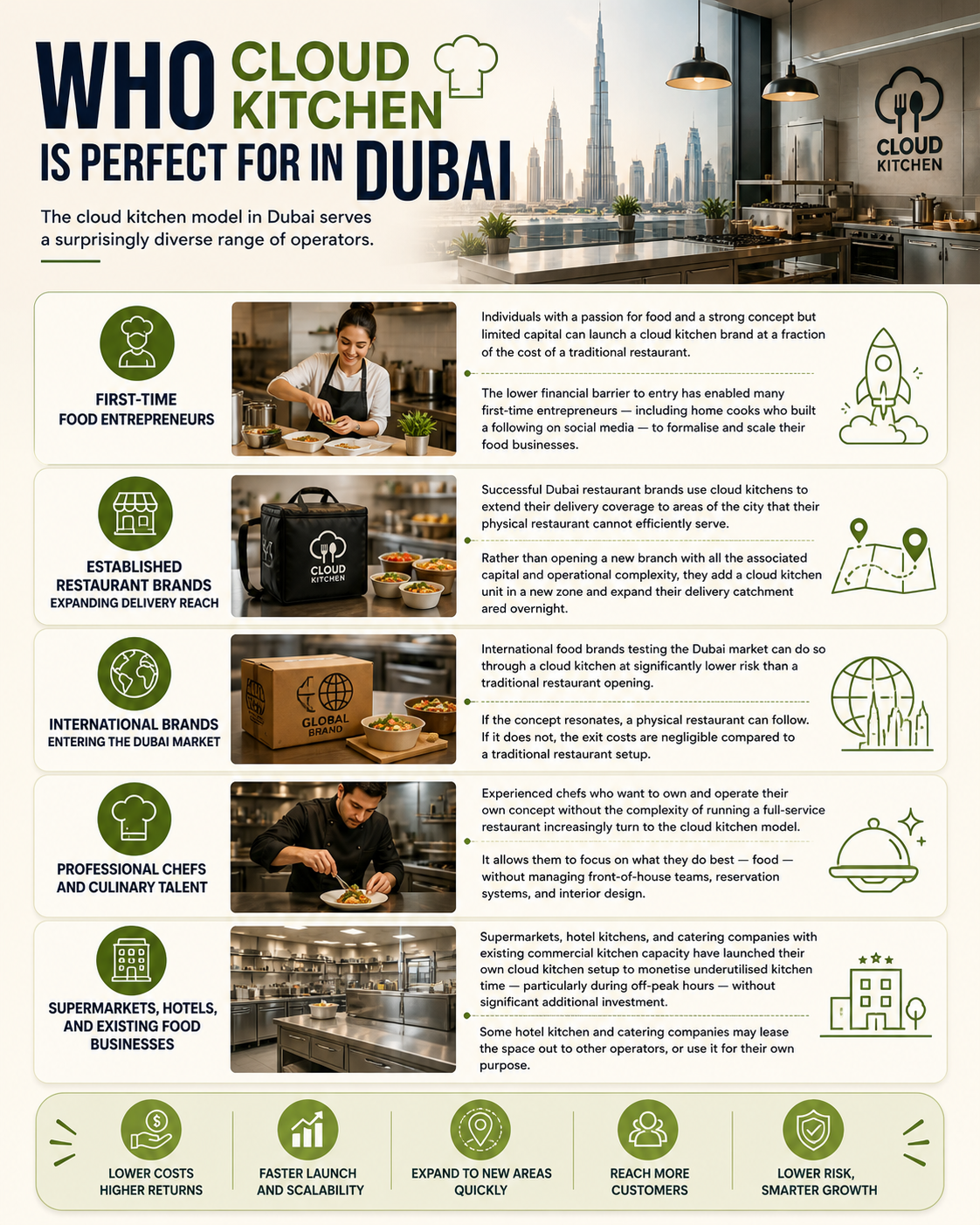
The cloud kitchen model in Dubai serves a surprisingly diverse range of operators:
- First-time food entrepreneurs
Individuals with a passion for food and a strong concept but limited capital can launch a cloud kitchen brand at a fraction of the cost of a traditional restaurant.
The lower financial barrier to entry has enabled many first-time entrepreneurs — including home cooks who built a following on social media — to formalise and scale their food businesses.
- Established restaurant brands expanding delivery reach
Successful Dubai restaurant brands use cloud kitchens to extend their delivery coverage to areas of the city that their physical restaurant cannot efficiently serve.
Rather than opening a new branch with all the associated capital and operational complexity, they add a cloud kitchen unit in a new zone and expand their delivery catchment area overnight.
- International brands entering the Dubai market
International food brands testing the Dubai market can do so through a cloud kitchen at significantly lower risk than a traditional restaurant opening.
If the concept resonates, a physical restaurant can follow. If it does not, the exit costs are negligible compared to a traditional restaurant setup.
- Professional chefs and culinary talent
Experienced chefs who want to own and operate their own concept without the complexity of running a full-service restaurant increasingly turn to the cloud kitchen model.
It allows them to focus on what they do best — food — without managing front-of-house teams, reservation systems, and interior design.
- Supermarkets, hotels, and existing food businesses
Supermarkets, hotel kitchens, and catering companies with existing commercial kitchen capacity have launched their own cloud kitchen setup to monetise underutilised kitchen time — particularly during off-peak hours — without significant additional investment.
Some hotel kitchen and catering companies may lease the space out to other operators, or use it for their own purpose.
Key benefits of the cloud kitchen model
Lower startup costs compared to full restaurant setup
The elimination of front-of-house design, prime location rent, and customer-facing fit-out reduces initial capital requirements dramatically compared to a traditional restaurant.
In Dubai, a cloud kitchen brand can often be launched for under AED 400,000 — including first year rent, licensing and similar setup cost.
This cost estimate does not factor in salary or kitchen equipment.
- It is also necessary to consider the commission that food ordering platform charges, often 30-35% per order, when developing a financial model for launching a cloud kitchen food business.
Faster time to market
Without the lengthy fit-out, municipality inspections specific to dine-in establishments, and recruitment of front-of-house staff, a cloud kitchen can go from concept to first order in weeks rather than months.
Multiple revenue streams from one facility
Running multiple brands from one kitchen spreads fixed costs — rent, utilities, core kitchen staff — across multiple revenue streams.
- A kitchen generating revenue from five brands simultaneously has a fundamentally different cost structure from a single-brand restaurant.
Data-driven menu optimization
Because all orders flow through digital platforms, cloud kitchen operators have access to granular data on what sells, when it sells, at what price point, and to which customer segments.
This data enables rapid menu iteration and optimisation that is simply not available to traditional restaurants in the same form.
Scalability
A successful cloud kitchen brand can be replicated in a new kitchen location — in a new area of Dubai, in Abu Dhabi, in Riyadh, or in any city where the kitchen infrastructure exists — without the full complexity of a traditional restaurant rollout.
Cloud kitchens in Dubai — the local landscape
Dubai is one of the world’s most developed markets for the cloud kitchen model, driven by a combination of factors that make the city uniquely suited to delivery-first food businesses.
The market has grown dramatically since 2019 and accelerated sharply during and after the COVID-19 pandemic, which permanently shifted consumer behaviour towards food delivery.
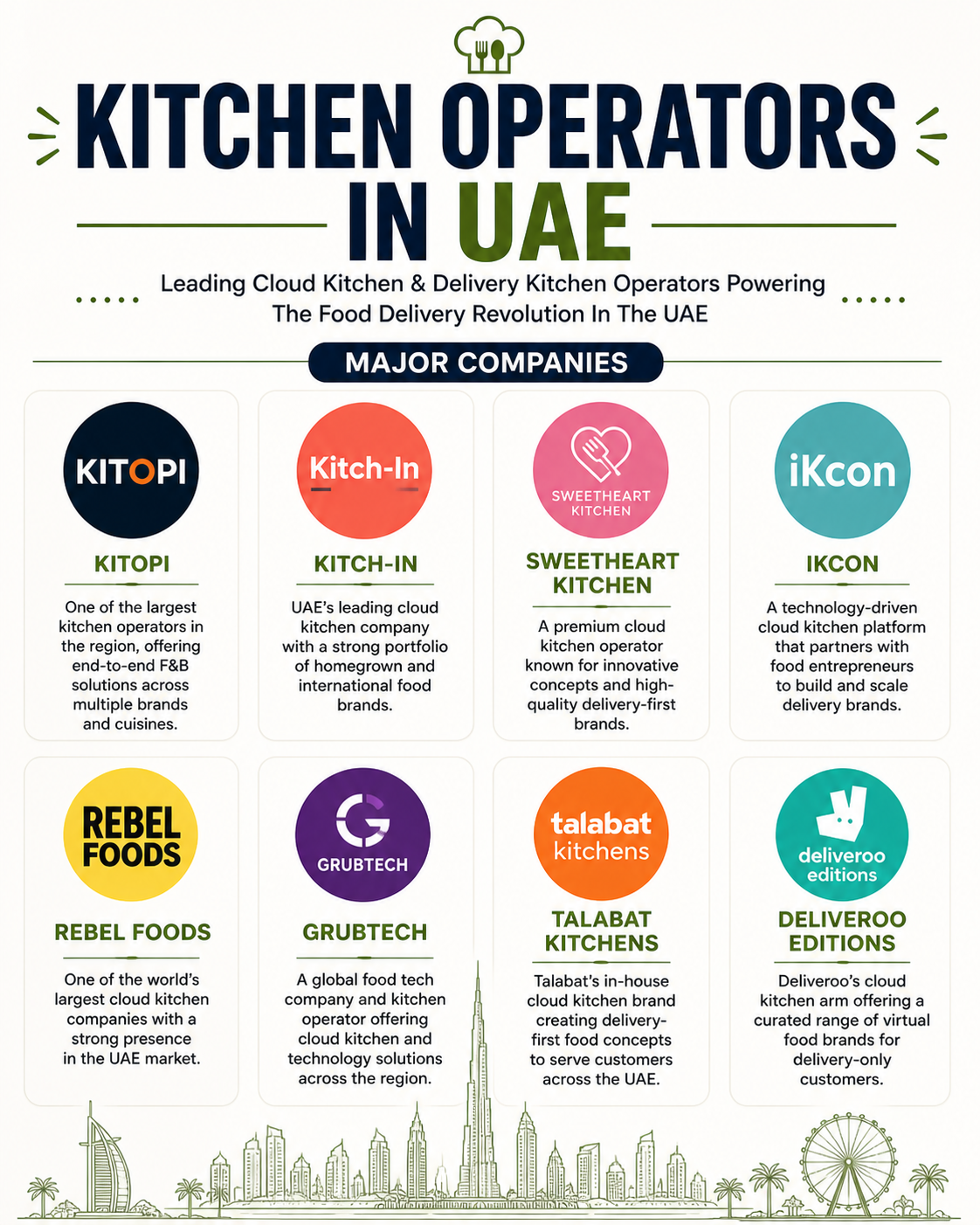
As operators come and go, major cloud kitchen operators and networks active in Dubai as of 2026 include:
- Kitopi — arguably the most prominent cloud kitchen operator in the MENA region, founded in Dubai in 2018.
- Kitopi operates a managed cloud kitchen model, partnering with existing restaurant brands and handling the kitchen operations, allowing the brand to expand to new locations without managing the kitchen directly.
- Kitopi has expanded across the UAE, Saudi Arabia, and internationally.
- Sweetheart Kitchen — one of Dubai’s original and best-known cloud kitchen networks, operating multiple delivery brands from its facilities and widely credited with pioneering the model in the UAE market.
- iKcon — a Dubai-based cloud kitchen infrastructure provider offering fully equipped kitchen spaces and technology solutions to food brands wanting to launch or expand their delivery operations.
- The Kitchen (various operators) — numerous independent cloud kitchen facilities operate across Dubai’s industrial zones, renting kitchen space to individual food entrepreneurs and brands on shared or dedicated terms.
- Established restaurant groups — including international chains and homegrown Dubai F&B brands — have also established their own proprietary cloud kitchen operations, running delivery-only brands from centralised kitchen facilities to supplement or replace traditional restaurant expansion.
Challenges to be aware of
1) High delivery platform commission
Delivery platform commissions of 15% to 30% are a significant margin pressure. Cloud kitchen operators must carefully manage food costs, portion sizes, and menu pricing to maintain profitability after platform fees are deducted.
2) Brand visibility and customer discovery
Without a physical storefront, customer discovery depends entirely on delivery platform algorithms, ratings, reviews, and digital marketing. Building brand recognition and customer loyalty without a physical presence requires deliberate, sustained investment in digital marketing and customer experience.
3) Delivery quality control
The quality of the customer experience is partly outside the operator’s control once the food leaves the kitchen. Delivery time, driver professionalism, and packaging integrity all affect the customer’s perception of the brand — and the review they leave — even when the food itself is excellent.
4) Market saturation in some categories
Dubai’s cloud kitchen market has grown rapidly, and some food categories — particularly burgers, shawarma, and pizza — have become highly competitive on delivery platforms. New entrants in saturated categories face significant marketing investment to achieve visibility.
Starting a cloud kitchen in Dubai — what you need to know
For those wondering how to start a cloud kitchen business in Dubai, the key steps and requirements include:
1. Trade license
A food and beverage trade licence is required from the Department of Economic Development (DED) for mainland operations, or from the relevant free zone authority if operating within a free zone. The licence activity should specifically cover food preparation and delivery.
2. Dubai Municipality approval
The kitchen facility must be approved by the Dubai Municipality’s Food Safety Department. This involves an inspection of the kitchen premises against food safety standards covering layout, equipment, ventilation, waste management, pest control, and hygiene protocols. All food handlers must hold valid food safety certificates.
3. Kitchen space
You can either lease space within an established cloud kitchen facility — where shared infrastructure, utilities, and sometimes platform relationships are included — or fit out your own dedicated kitchen unit. Shared cloud kitchen facilities offer a faster and lower-cost entry point; a dedicated kitchen gives greater control and flexibility.
4. Delivery platform onboarding
Once licensed and operational, register your brand on Talabat, Deliveroo, Noon Food, and other relevant platforms. Platform onboarding typically involves submitting your licence documents, menu, photography, and banking details. Most platforms can activate a new restaurant listing within one to two weeks of receiving complete documentation.
5. Food safety and HACCP compliance
All food preparation in Dubai must comply with Dubai Municipality’s food safety requirements, including Hazard Analysis and Critical Control Points (HACCP) principles. A food safety management system must be documented and implemented, and records of temperature monitoring, cleaning schedules, and supplier verifications must be maintained.
*Whether you’re looking to set up a virtual kitchen, dark kitchen, cloud or ghost kitchen in Dubai, Abu Dhabi, Sharjah, Al Ain, Ajman, Ras Al Khaimah, Umm Al Quwain or Fujairah, the process is similar.
Frequently asked questions About setting up a virtual kitchen in Dubai, Abu Dhabi, Sharjah, Al Ain, Ajman, Ras Al Khaimah, Umm Al Quwain, Fujairah
Is a cloud kitchen the same as a ghost kitchen in Dubai?
Yes — in Dubai and across the MENA region, cloud kitchen, ghost kitchen, virtual kitchen, and dark kitchen all refer to the same type of operation: a licensed commercial kitchen that prepares food exclusively for delivery, with no dine-in or walk-in customer service.
The different names reflect different naming conventions from different industries and geographies, not different business models.
Do I need a separate licence for each brand I operate from one cloud kitchen?
This depends on the structure of your operation and the specific guidance from the DED and Dubai Municipality at the time of your application.
In general, a single kitchen facility requires a single food safety approval, but each distinct brand may require separate registration on delivery platforms and may need to be reflected in your trade licence activity.
How much does it cost to start a cloud kitchen in Dubai?
Costs vary significantly depending on whether you are leasing space in an existing cloud kitchen facility or setting up your own dedicated kitchen.
Leasing space in an established facility can start from AED 8,000 to AED 15,000 per month depending on size and location, with lower upfront capital requirements.
A dedicated kitchen fit-out will require a more significant upfront investment but gives greater operational control. Licence and municipality approval costs are additional.
Which delivery platforms should I use in Dubai?
Talabat is the dominant food delivery platform in Dubai and the wider UAE, with the largest customer base and order volume.
Deliveroo has a strong presence particularly in premium residential and business areas. Noon Food has grown its market share significantly.
Most cloud kitchen operators in Dubai list on multiple platforms simultaneously to maximise order volume and reduce dependency on any single platform.
Can I operate a cloud kitchen from my home in Dubai?
No — commercial food preparation for sale and delivery in Dubai requires a licensed commercial kitchen premises that meets Dubai Municipality’s food safety standards.
Home kitchens do not meet these standards and are not eligible for the required licences.
Operating a food delivery business from home without the appropriate licences and approvals is illegal in Dubai.
Does a cloud kitchen need to display its address publicly?
No — the kitchen address does not need to be displayed on delivery platforms or marketing materials in the way that a traditional restaurant address would be.
The kitchen must have a registered address for licensing and regulatory purposes, and delivery drivers need to be able to locate it for collections, but the address is not a customer-facing element of the brand.
setting up cloud kitchen in Dubai Summary
Cloud kitchen, ghost kitchen, and virtual kitchen are three names for one business model. In Dubai — and globally — they all describe the same thing: a licensed, professional commercial kitchen that prepares food exclusively for delivery, operates without a dine-in space or walk-in customers, and builds its brand entirely in digital space through food delivery platforms and social media.
The name you use — cloud, ghost, or virtual — reflects where you encountered the term, not any meaningful operational distinction.
- Cloud kitchen comes from the technology world. Ghost kitchen comes from US media coverage.
- Virtual kitchen comes from brand-focused operators.
- Dark kitchen comes from the UK.
In Dubai, cloud kitchen is the most commonly used term in business and regulatory contexts, but all four are understood and accepted.
What matters is not the name but the model itself — and it is a model that Dubai is exceptionally well positioned to support.
- High food delivery adoption, expensive retail rents, a diverse and food-adventurous population, a supportive regulatory framework, and a deeply entrepreneurial culture have made Dubai one of the world’s leading cloud kitchen markets.
Whether you are an entrepreneur considering your first food business, an established restaurant brand looking to expand your delivery reach, or an investor evaluating the Dubai F&B sector, the cloud kitchen model — under whatever name you choose to use — represents one of the most significant and durable structural shifts in the food industry in recent memory.
How BUH consulting can assist
Whether you are a local resident, existing F&B business in UAE or international restaurant looking to start a cloud pitch in business in UAE, our team will work with you to understand your requirements, and suggest the most suitable setup.
We can advise on:
- Business plan.
- Best type of cuisine based on neighbourhood.
- Comapny incorporation.
- Key rental locations.
- Market Analysis.
- Purchasing of new or used kitchen equipment.
- Renting of cloud kitchen space.
- Strength, Weakness, Opportunity and Threat analysis (SWOT).
- Understanding licensing and regulatory requirements.
Contact information
For a tailored solution, contact us to discuss about your requirements.
Email: – sam@buh-consulting.com
Phone: +971585086656
Whatsapp: +971585086656
Telegram: BUHConsultingAE