
What documents can be legalized in UAE
understanding which type of document can be legalized
In the UAE, the range of documents that can be certified or legalized is broad, covering almost every aspect of personal and professional life.
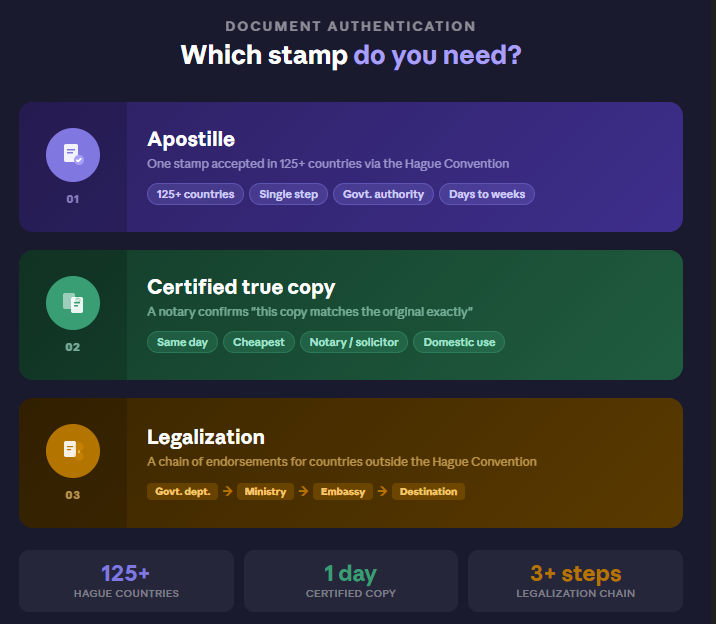
There are three types of methods that a document can be accepted for international use:
- Apostille – Not available in UAE as the country is not a member to the Hague Convention.
- Attestation – Also known as legalization.
- Certified True Copy.
Depending on the document’s purpose, the process will either be a simple Certified True Copy (local/banking use) or a full Attestation (government/visa/international use).
Common documents that require legalization before they can be used overseas
1. Personal & Vital Documents
These are the most common documents required for residency, family sponsorship, or marriage.
- Conduct & Security: Good Conduct/Police Clearance Certificates (PCC).
- Health: Medical reports, sick leave certificates, and fitness results from DHA or MOHAP.
- Identification: Passport copies, Emirates ID, Family Book.
- Vital Certificates: Birth, Marriage, Death, and Divorce certificates.
2. Educational & Professional Documents
Required for work permits, school enrollment, or professional licensing.
- Academic Records: Degrees, Diplomas, Ph.D. certificates, and official transcripts.
- Professional Standing: Experience certificates, professional licenses (e.g., medical or engineering), and job offer letters.
- Student Status: “To Whom It May Concern” letters from schools or universities.
3. Corporate & Business Documents
Essential for setting up a business, opening corporate bank accounts, or signing commercial contracts.
- Foundational Documents: Trade Licenses, Memorandum of Association (MOA), Articles of Association (AOA).
- Company Records: Board Resolutions, Minutes of Meetings, Share Certificates, and Certificates of Incumbency.
- Financials: Audited financial statements, bank statements, and tax certificates.
- Operational: Commercial Invoices, Certificates of Origin, and Brand/Trademark registrations.
4. Legal & Judicial Documents
Documents that grant authority or act as legal evidence.
- Powers of Attorney (PoA): Both personal (family/property) and commercial (business management).
- Affidavits: Sworn declarations, consent letters (e.g., for child travel), and personal undertakings.
- Contracts: Tenancy contracts (Ejari), sales and purchase agreements (SPA), and partnership agreements.
- Court Orders: Judgments, heirship certificates, and guardianship orders.
5. Administrative & Miscellaneous
Translated Documents: Legal translations of any of the above documents (must be certified by a Ministry of Justice-approved translator).
Utility Proofs: DEWA/SEWA bills (certified as proof of address).
Photographs: Certified as a true likeness for official applications.
Important information for documents that require legalization
Origin Rule: A document can only be certified from the original. Agencies cannot certify a “copy of a copy.”
No Lamination: Authorities like MOFA will reject any document that is laminated, as they cannot apply stamps or seals.
Translation: If the original document is not in Arabic or English, it must be legally translated by a licensed translator before certification.
Digital Integration: Many UAE-issued documents (like DHA medical reports or Dubai Courts marriages) are now Digital-First. These often come with a QR code and can be attested instantly via the MOFA UAE app using your UAE Pass.
Should a document be legalized, certified or Apostille
Understanding the difference between certification, apostille, and attestation is essential for anyone handling legal paperwork across international borders.
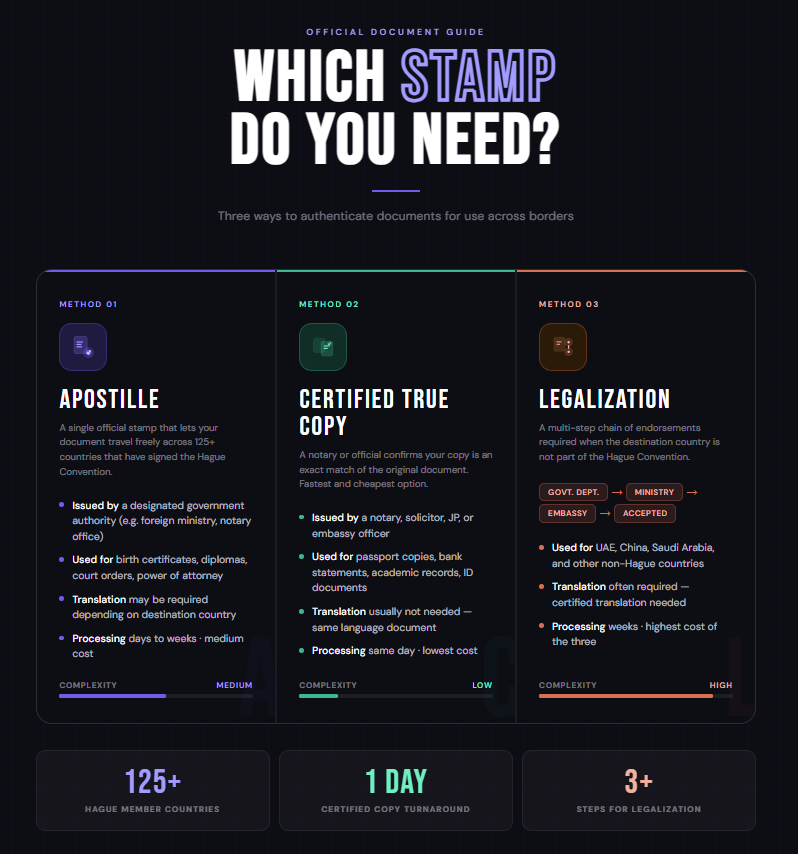
what is the difference between apostille, certified True Copy and Attestation?
While they all aim to verify a document’s legitimacy, they require legalizing at different levels of authority and each method serves its own purpose.
1. Certification (The “True Copy”)
Certification is the most basic level of verification. It is a professional confirmation that a photocopy is an exact, unaltered replica of an original document.
- Who does it: Licensed lawyers, Notaries Public, or sometimes community professionals (like doctors or police officers) depending on the country.
- What it proves: It only proves the copy is “true.” It does not verify the document’s legal validity or the authority of the original signer.
- Best for: Internal bank records, job applications, or proof of address.
2. Apostille (The “Fast Track”) -not available in United Arab Emirates
An Apostille is a standardized certificate used only between countries that are members of the Hague Convention (e.g., USA, UK, Australia, India, and most of Europe).
- Who does it: A designated central government authority in the country where the document was issued (e.g., the Secretary of State in the US or the FCDO in the UK).
- What it proves: It verifies the authenticity of the signature, seal, and position of the official who issued the document.
- The Benefit: It is a one-step process. Once a document has an Apostille, it is automatically accepted in all other Hague member countries without further stamps.
It is important to note that UAE is not part of the Hague Convention and therefore, it is not possible to apostille a document in UAE, nor is an apostilled document from overseas accepted as a legalized document in UAE.
3. Attestation (The “Legalization Chain”)
Attestation is a multi-step “chain of trust” required when at least one of the countries involved is not a member of the Hague Convention (e.g., the UAE, Saudi Arabia, or China).
- The Drawback: It is slower and more expensive than an Apostille due to the multiple layers of government involvement.
- Who does it: A series of authorities, typically involving:
- A local Notary.
- The Ministry of Foreign Affairs (MOFA) in the home country.
- The Embassy of the target country.
- The MOFA in the target country (e.g., MOFA UAE).
- What it proves: It provides the highest level of government-backed verification for international use.
Is it better to legalize a document by attestation or certify a document as true copy?
FAQ: documentation or true copy certification: which one is better?
Depending on where the document is to be used and who is requesting it, one route may be selected over another.
Can a family member certify a true copy of my document?
No.
The certifier must be an independent third party with no personal interest in the document.
A family member, spouse, or anyone who lives at the same address as you cannot certify your documents, even if they hold a qualifying professional title.
It is however, possible for a family member to take a document for certification on your behalf.
Does a certified true copy need to be in the same language as the original?
Yes — a certified true copy is a copy of the original, so it will be in the same language.
If the receiving institution requires the document in a different language, you will need a separate certified translation in addition to the certified true copy.
The person responsible for certifying the document may request the document to be translated before providing service.
Can I certify a digital document or a scanned PDF?
In most traditional contexts, the certifier needs to physically compare the copy against the original document in person.
However, some jurisdictions and institutions now accept electronic certified copies with a digital signature.
Is a notarized copy the same as a certified true copy?
In most cases, yes — a notarized copy is a certified true copy produced by a notary public.
Some jurisdictions use the terms interchangeably, though “notarized” may carry additional legal weight in certain legal systems (particularly civil law countries).
Can I use a certified true copy instead of the original?
For most administrative purposes, yes. Banks, employers, universities, and government departments routinely accept certified true copies in place of originals.
However, some processes — such as certain court proceedings or property transactions — may specifically require the original document or a document that has been attested, meaning a document has to go through the complete legalization process with various Embassies, Consulates and Ministry of Foreign Affairs.
How many certified copies do I need?
It depends on how many institutions or authorities need a copy.
Each institution will typically need its own original certified copy.
It is advisable to get at least three to four certified copies of key documents such as your passport or birth certificate in one sitting, to avoid repeat visits to a certifier.
Is a certified true copy the same as an apostille?
No — these are different things. A certified true copy confirms the copy is accurate.
An apostille is an international authentication stamp that verifies the signature and seal of the certifier, allowing the document to be used in countries that have signed the Hague Convention.
Many international document submissions require a certified copy that has then been apostilled.
Is a certified true copy the same as Legalization (Attestation)?
No — in most cases, a certified true copy cannot be used in any legal proceedings, where as a legalized document is the only form of acceptance.
A file that has been attested (legalized) trumps all other form of legitimizing a document.
How BUH consulting can assist
Whether you require a document to be certified as a true copy or legalized with the UAE Ministry of Foreign Affairs, BUH Consulting’s document attestation team can get the job done quick.
Our team maintains great relations with all stakeholders, allowing documents to be process in a timely fashion.
Contact information
For a tailored solution, contact us to discuss about your requirements.
Email: – sam@buh-consulting.com
Phone: +971585086656
Whatsapp: +971585086656
Telegram: BUHConsultingAE