
How to apply tax residency certificate without living in the country
The Standard 183‑Day Rule
In most countries, you generally cannot become a tax resident of a country with literally zero presence, as nearly all countries require to spend a minimum of 183 days in the country before you can be considered tax resident of the country.
However, special tax regime programs in investment oriented countries let you obtain tax residency or a special tax status, with very light physical presence to no physical requirement, as long as you build other strong ties (home, investments, centre of interests) and stay compliant globally.
Worldwide Tax vs In Country Generated Tax
As most countries use some variation of the “183‑day rule” as a primary test for tax residency, meaning if you spend 183 days or more in a country in a year, you’re usually treated as a tax resident and whether you are taxed on some or all of your worldwide income, varies from one country to another.
Many jurisdictions also treat you as tax resident even below 183 days if:
- Your main home (permanent dwelling) is there.
- Your closest personal and economic ties (“centre of vital interests”) are there.
- You work there full‑time or run a business primarily from there.
So in most countries, you either cross 183 days, or you become resident because your life is clearly centred there.
Special Tax Regimes That Does Not Consider 183 Days
To attract foreign investment, some countries offer residency or tax regimes that DO NOT REQUIRE you to spend 183 days (or any time) in the country, provided you meet other conditions (investment, property, minimum tax, as well as not being tax resident elsewhere).
- When considering pursing a special tax residency status of one country, it is still possible to hold residency status of another.
- The difference being a tax special resident and resident a foreign country, is that you should NOT spend more than 183 days in the country where you do not intend to be a tax resident.
- It is possible to hold a tax residency of one country, while not becoming a tax resident of the same.
- For Example, Malta has a special tax program for those seeking to obtain the tax status of Malta, while you do not have to live in Malta along with the rule that you cannot spend more than 183 days in another country.
- The ideal scenario would be to spend 182 days in the country of permanent place of residency, while the remainder of the year (183 days) is spent elsewhere, which is an ideal scenario for retirees or those who work as a digital nomad.
- For Example, Malta has a special tax program for those seeking to obtain the tax status of Malta, while you do not have to live in Malta along with the rule that you cannot spend more than 183 days in another country.
- It is possible to hold a tax residency of one country, while not becoming a tax resident of the same.
- The difference being a tax special resident and resident a foreign country, is that you should NOT spend more than 183 days in the country where you do not intend to be a tax resident.
Common patterns in these regimes include:
- A lower minimum stay (for example, around 90 days per year) plus a rule that you do not spend 183 days in any other single country.
- No published minimum stay, but a requirement not to become tax resident in another jurisdiction and to maintain a home, insurance and minimum tax payment in the country.
- Residency permits without automatic tax residency, where you can hold legal residence but only become a tax resident if you cross a day‑count or build strong ties.
Most tax free residencies are not “zero‑day” solutions (with the exception of Malta); they are low‑presence or flexible‑presence frameworks that you must coordinate carefully with other countries’ rules and tax treaties.
Countries That Offer Tax Residency Without Living In The Country
Not many countries are willing to offer a tax residency status without a person properly living in the country for 183 days. However, there are certain investment focused countries that offer such options, with the main country that has attracted global interest being Malta.
Malta’s Global Residence Programme (GRP) Explained
Malta is often cited because the Global Residence Programme (GRP) and related regimes provide a special tax status without a published 183‑day minimum stay, focusing instead on where else you spend your time and how you structure your ties.
Under the GRP, eligible non‑EU/EEA/Swiss nationals can obtain a residence permit plus “special tax status” with:
- A 15% flat tax on foreign income remitted to Malta, with a minimum annual tax of €15,000, covering the applicant and dependants.
- Foreign‑source income kept outside Malta remaining untaxed in Malta, and foreign‑source capital gains generally outside scope if not Maltese.
- Official GRP guidelines emphasizes that beneficiaries must not spend more than 183 days in any other single jurisdiction in a calendar year.
- There is no explicit minimum stay in Malta for GRP status; instead, Malta tries to avoid conflict with other countries that might claim you as resident based on their 183‑day rule, and therefore, mandates that those obtained Malta’s Global Residence Programme are not allowed to stay in another country for more than 182 days (it is highly recommend to leave one day of breathing space in case of miscalculation)
- Separate Maltese tax‑residence guidance still looks at objective factors like having a permanent home in Malta rented or purchased, and an intention to reside there ordinarily (periodically).
- Currently, the requirement to reside in Malta for any period of time under the Malta Residency Programme is not enforced practice, but it is recommended to spend some time in Malta and showing real links, to avoid issues at the time of annual renewal of the GRP (Global Residence Programme).
While Malta’s GRP does not have any official residency requirements, it is designed for internationally mobile people who live part‑time in several places, while treating Malta as their main fiscal base and avoiding full residency elsewhere.
Malta Global Residence Programme (GRP) Eligibility Assessment
Malta special tax regime is eligible to most applicants who are non European and are looking to establish minimal presence in Malta to obtain tax residency status.
- Check eligibility
You must be a non‑EU/EEA/Swiss national, financially self‑sufficient, properly insured, and not benefiting from another Maltese residence program. - Secure qualifying property in Malta
Buy or rent a home that meets minimum value/rental thresholds set by the law (e.g. specific purchase/rent minimums that are periodically updated). - Complete GRP’s due diligence process
Applications for GRP special tax status including due‑diligence checks and detailed documentation of income and background. - Obtain “special tax status” and residence card
Once approved, the Commissioner issues a letter of approval and you finalise property rental or purchase in Malta, international health insurance with coverage for Malta is to be purchased and the €15,000 minimum tax payment must be paid to activate the special status.- After all of the above have been completed, Malta’s 0 day tax residency status certificate is issued and the applicant is now officially, a tax resident of Malta without official requirement to physically live in Malta.
- Maintain compliance annually
You must keep the qualifying property, maintain health insurance, pay the annual minimum tax, refrain from spending 183+ days in any other country, and continue to meet general Maltese tax‑residence criteria, in order to renewal your non resident tax status with the Global Residence Programme in Malta.
How to apply for tax residency without living in country
Other tax friendly jurisdictions that offer a variation of non‑dom residency status (meaning non domicile or without having to reside in the country) or flat‑tax regimes where:
- You become tax resident in the country (often by living there most of the year, in most cases more than 183 days), but Foreign‑source income is taxed lightly or not at all, sometimes under a fixed annual lump‑sum tax.
Strategy: applying for tax residency with minimal living time
If your goal is obtain tax residence status with a light‑presence requirement rather than a place you live 365 days a year, a typical compliant strategy involves:
- Document everything and coordinate treaties
Maintain travel logs, proof of property, tax residency certificates, and advice letters, and check relevant double tax treaties to see how conflicts between countries would be resolved
- Clarify your current home country rules
Understand how your existing country defines tax residency, exit rules, and whether it has CFC (Controlled Foreign Company) for businesses, exit tax or worldwide tax for citizens (e.g. US citizens taxed on worldwide income regardless of residence).
- Choose a jurisdiction with a compatible regime
Look for countries that either:
- Offer a special tax status with low minimum stay (e.g. Malta GRP, Bahamas 90‑day model); or
- Allow you to hold residency without automatic tax residency (e.g. some residency‑by‑investment schemes in tax‑free jurisdictions).
- Ensure you don’t accidentally create tax residency elsewhere
Keep your days in any other single country below 183 and avoid building strong personal/economic ties that let that country claim you as resident under tie‑breaker or “centre of vital interests” tests.
- Build genuine links to your chosen tax base
Acquire qualifying property by renting or purchasing, spend enough time to be credible, open local bank accounts, and move at least some economic activity or asset management there.
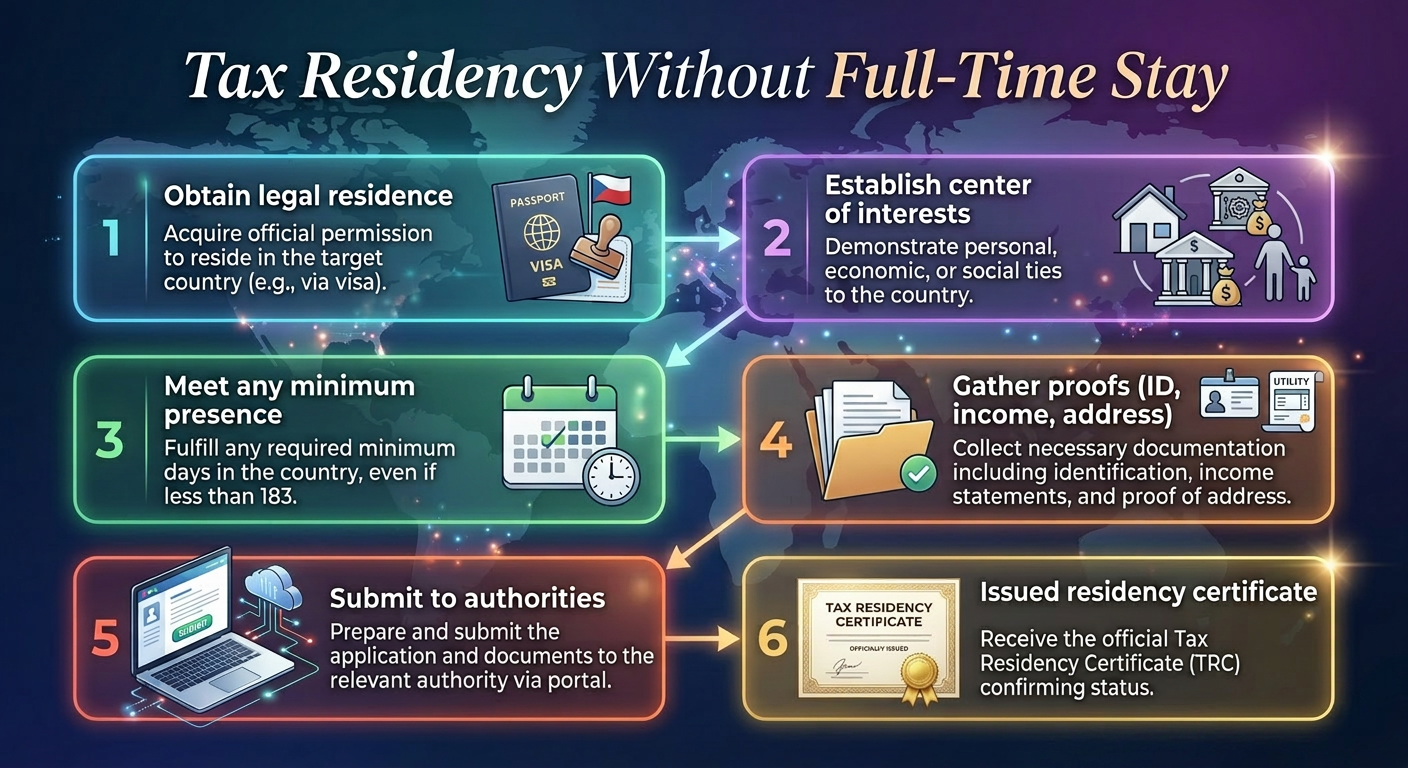
Important Guideline When Planning a Global Tax Residency Structure
- “Zero days” is not realistic in most countries: regimes marketed as “no‑presence tax residency” almost always require either some presence, a real home, or evidence that your centre of life is there; tax authorities and the OECD (Organisation for Economic Co-operation and Development) have targeted purely paper‑based residencies.
- CRS and information exchange: tax residency certificates are now widely used for Common Reporting Standard (CRS) reporting; making a false claim can create serious legal risk.
- Multi‑country conflicts: even if Country A recognizes you as tax resident, Country B might still consider you resident under its rules (for countries that tax residence on worldwide income regardless of time spent in the country); you then rely on treaty tie‑breakers, which require strong evidence and correct filings.
How BUH consulting can assist
BUH Consulting’s global residency relocation team will work with you to understand your requirements and suggest a list of most suitable countries that can accomplish your residency and tax goals.
With options to obtain tax resident status without residing in the country, as well as options in jurisdictions that requires low residency requirement in order to be considered a tax resident, BUH Consulting has the perfect solution for achieve your financial and residency goals.
Contact information
For a tailored solution, contact us to discuss about your requirements.
Email: – sam@buh-consulting.com
Phone: +971585086656
Whatsapp: +971585086656
Telegram: BUHConsultingAE