
The Ultimate Guide to Starting a Cloud Kitchen restaurant business in Dubai (2026)
Process To Open a Ghost Kitchen in Dubai
The food delivery market in Dubai is no longer just a trend—it is a cornerstone of the city’s economy. With the rise of “dark kitchens” or “ghost kitchens,” entrepreneurs can now launch multiple food brands without the overhead of a physical restaurant.
If you are looking to open a cloud kitchen (also known as Ghost Kitchen) in Dubai, this guide covers everything from licensing costs and Dubai Municipality requirements to choosing between a Mainland and Free Zone setup.
Opening a ghost kitchen (or cloud kitchen) in Dubai is a lengthy process that can be reward if you can tick all the check boxes.
In 2026, just having the best food is not good enough, you need the whole ecosystem to work hand in hand from packaging, presentation, marketing, taste, customer service, speed and along with many, many additional factors.
How to Find a Cloud Kitchen for Rent in Dubai
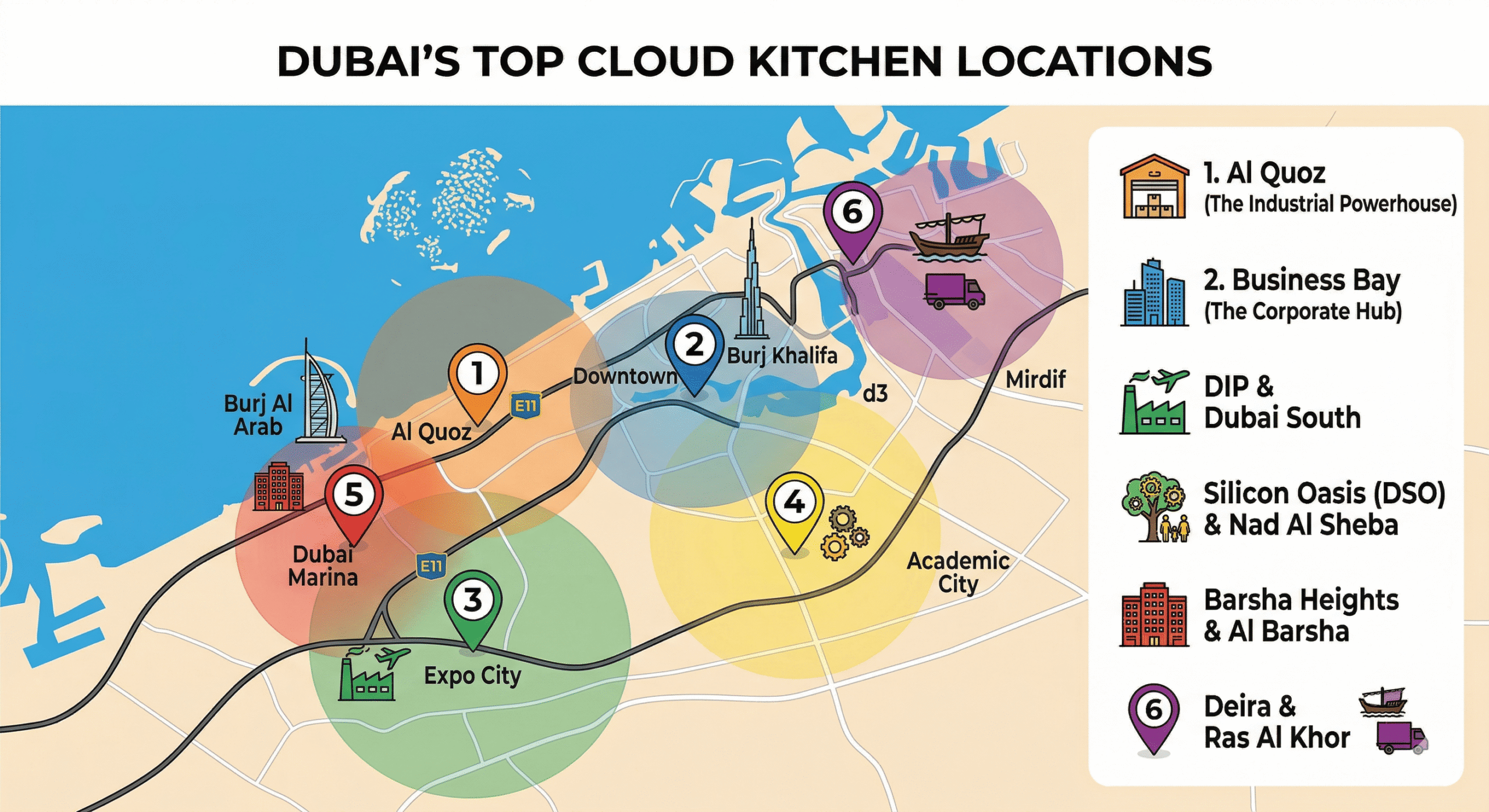
While locations for rent to start a cloud kitchen business can be found all over Dubai, there are several areas are the most popular and common for businesses looking to start a cloud kitchen for food and beverage companies for the first time.
THE SECRET: In order to achieve success, high visibility and fast delivery times (the two most critical metrics for a ghost kitchen), you need to balance lower industrial rent with proximity to high-density residential areas.
In 2026, these are the most popular and strategic locations for renting cloud kitchens space in Dubai:
1. Al Quoz (The Industrial Powerhouse)
Al Quoz remains the #1 destination for cloud kitchens in Dubai.
- Why: It is an industrial zone with large warehouses, meaning lower rents and the ability to build massive facilities.
- Delivery Reach: Its central location provides “Golden Circle” access to Downtown Dubai, Business Bay, Al Safa, and Jumeirah within 15–20 minutes.
2. Business Bay (The Corporate Hub)
This is the primary choice for brands targeting the professional “lunch rush.”
- Why: High-rise density means thousands of hungry office workers in a small radius.
- Delivery Reach: Efficient access to DIFC, Downtown, and the luxury residences of Sheikh Zayed Road.
3. Dubai Investment Park (DIP) & Dubai South
As Dubai expands toward the Expo 2020 site and Al Maktoum International Airport, these areas have become cloud kitchen hotspots.
- Why: Lower costs and proximity to massive new residential communities like Damac Lagoons and Tilal Al Ghaf.
- Delivery Reach: Serves Jebel Ali, Expo City, and the villa communities along Emirates Road.
4. Silicon Oasis (DSO) & Nad Al Sheba
A favorite for family-oriented food brands and healthy meal-prep concepts.
- Why: DSO is a “city within a city” with a high concentration of tech professionals and young families.
- Delivery Reach: Excellent coverage for Academic City, Meydan, and the Villa communities.
5. Barsha Heights (TECOM) & Al Barsha
Perfect for brands targeting the diverse expat population and mid-range “casual dining” delivery.
- Why: It is one of the most densely populated residential areas in Dubai.
- Delivery Reach: Centralized access to The Greens, Dubai Marina, and Jumeirah Village Circle (JVC).
6. Deira & Ras Al Khor
For entrepreneurs focusing on high-volume, affordable, or ethnic cuisines.
- Why: These areas offer some of the most competitive rental rates in the city.
- Delivery Reach: Ras Al Khor is particularly strategic for reaching Dubai Design District (d3) and Mirdif.
Is it better to set up a cloud kitchen in a free zone or mainland in dubai
1. Choose Your Cloud Kitchen Business Model
Before applying for a license, you must decide how you will operate. In 2026, there are three primary models in Dubai:
- Independent Cloud Kitchen: You rent a private commercial space and build your own kitchen from scratch.
- This option gives you the most control over your setup but it’s also the most expensive.
- Shared Kitchen Space: You rent a “plug-and-play” station within a larger facility (like KitchenPark, Talabat or Kitopi).
- This is the fastest way to market as everything is already setup, bring in your appliances and start operating.
- Virtual Brand Expansion: Existing restaurants use their current kitchen to launch a new, delivery-only brand.
- You can also negotiate with other businesses make your food under their company’s brand.
2. Selecting the Right Jurisdiction: Mainland vs. Free Zone
| Feature | Mainland (DTCM/DED) | Free Zone (e.g., IFZA, Dubai South) |
| Operational Reach | Deliver anywhere in Dubai/UAE | Restricted to the zone or via a distributor |
| Ownership | 100% Foreign Ownership | 100% Foreign Ownership |
| License Cost | AED 40,000 | AED 25,000 to 35,000 |
| Visas | Unlimited (based on office size) | Limited based on package |
3. Step-by-Step Licensing Process
Step A: Trade Name Reservation
Submit at least three name options to the Dubai Economy or Freezone and avoid names already in use, as well as names of Emirates while ensuring they reflect your food activity.
Step B: Initial Approval
This “no-objection” from the government allows you to proceed with your business setup while you finalize your kitchen location.
Step C: Dubai Municipality (DM) Food Safety Approval
Even without a dining area, your kitchen must meet the Dubai Food Code. You will need to submit a Kitchen Layout Plan that shows:
- Clear separation of raw and cooked food areas.
- Adequate ventilation and grease traps.
- Specified wash-up and storage zones.
4. Estimated Costs to Launch in 2026
Launching a cloud kitchen is cheaper than a restaurant, but small costs can add up.
- Trade License & Initial Approvals: AED 25,000 – AED 40,000
- Dubai Municipality Permits: AED 5,000 – AED 10,000.
- Shared Kitchen Rent (Monthly): AED 5,000 – AED 15,000.
- Staff Visas & Health Cards: AED 7,000 – AED 10,000 per employee.
5. Compliance and Health Requirements
Dubai Municipality is strict. To pass your final inspection, ensure the following:
- PIC (Person in Charge): At least one staff member must be a certified Person in Charge who has passed the DM food safety training.
- Grease Traps: Essential for all kitchens to prevent drainage blockages.
- Temperature Logs: Digital thermometers and logged records for all cold storage are mandatory.
- Pest Control: You must have a contract with a DM-approved pest control company.
6. Strategic Locations for High Demand
To maximize delivery speed, position your kitchen near high-density residential or business hubs:
- Al Quoz: Centralized, with easy access to Downtown, Business Bay, and Jumeirah.
- Ras Al Khor: Growing hub with lower rents than central Dubai.
- Silicon Oasis / Nad Al Sheba: High demand for mid-range family dining delivery.
- JLT / Dubai Marina: Prime for premium and healthy food concepts.
7. Marketing Your Cloud Kitchen
Since you have no “walk-in” traffic, your digital presence is your storefront.
Packaging: Invest in tamper-proof, visually appealing branded packaging that keeps food at the correct temperature during the humid Dubai summers.
Optimize for Delivery Apps: High-quality food photography is non-negotiable.
Google Business Profile: Even cloud kitchens should have a Google pin to capture local “near me” searches.
what is the Best Food Aggregator platform for cloud kitchens in Dubai
There are a number of points to consider such as which app is used by users different neighborhoods and parts of the city in Dubai.
- What works in one part of the city may not work in another. For a cloud kitchen to be successful in Dubai, it is necessary to consider factors such as:
- Audience and their app of preference
- Marketing strategy
- Language preference
- Spending power
If you’re looking to start a cloud kitchen in different emirates, the same point needs to be considered.
| Strategy | Primary Location | Top Delivery Aggregators |
| Highest Volume | Al Quoz | Talabat / Deliveroo |
| Highest Order Value | Business Bay | Deliveroo / Noon Food |
| Best Value Rent | Ras Al Khor | Talabat / Careem |
What is The Best Way to Start a Cloud Kitchen Business In Dubai
If you are a new brand Expanding into Dubai for the first time, shared Kitchen Providers (like Kitopi or KitchenPark) is the best way to test your strategy, they allow you to test these high-demand locations without the massive upfront cost of a private industrial fit-out.
Marketing is the KEY to success or PATH TO FAILURE, most of your resources should be dedicated in this area.
- Without a proper marketing strategy and agency to assist, the brand will find it difficult to break into the market.
It’s a Better to Start a Cloud Kitchen in Dubai Mainland or Freezone?
Choose Mainland IF: Your goal is to dominate the delivery apps (Talabat, Deliveroo, Careem) and you want the freedom to deliver to any customer, anywhere in Dubai. It offers the most “frictionless” experience for the food industry.
Choose Free Zone IF: You are testing a Minimum Viable Product (MVP), have limited startup capital, or your business model focuses on meal-prep kits and catering where you can manage distribution through a specialized third party.
- Free zones are usually located in high traffic community heavy area, which means you can also utilize your own delivery drivers to cut down on cost of relying on food delivery platforms like talabat, careem, deliveroo to improve delivery times,
Important Reminder: Regardless of your license, your kitchen layout MUST be approved by the Dubai Municipality and you must hold a HACCP certification or equivalent food safety clearance to legally sell food.
Frequently Asked Questions About Setting Up a Cloud Kitchen In Dubai
1. What is a Cloud Kitchen, and how does it differ from a Ghost Kitchen?
A common question that is asked is what is the difference between cloud kitchen and ghost kitchen in Dubai?
While often used interchangeably, for the purpose of investors to understand, there is virtually no differences:
- Cloud Kitchen: Generally refers to a commercial kitchen facility where multiple brands operate under one roof, focusing solely on delivery. The shared infrastructure often comes with pre-approved licenses and equipment.
- Ghost Kitchen: Also known as a “dark kitchen” or “virtual kitchen,” a ghost kitchen could be an independent unit, or it could operate within a shared cloud kitchen hub.
- Virtual Kitchen: A type of setup where the “restaurant” or brand only has a kitchen and no dining area and therefore is a delivery only concept which means cloud kitchen / ghost kitchen / virtual kitchen.
- Dark Kitchen: Another term that is used interchangeably different stakeholders, however it is the same meaning cloud kitchen and ghost kitchen.
In short, a ghost kitchen is the business model (delivery-only brand), while a cloud kitchen is the physical facility that enables it.
To keep things simple, cloud kitchen = ghost kitchen = virtual kitchen = dark kitchen.
2. Why are Cloud Kitchens so popular in Dubai?
Dubai’s dynamic food scene, high disposable income, and large tech-savvy expat population have created a booming food delivery market. The demand is further fueled by:
- Convenience: Fast-paced lifestyles and extreme weather during summer make food delivery highly attractive.
- Lower Costs: Significantly lower upfront investment compared to opening a traditional dine-in restaurant. No prime storefront rent, less interior décor, and reduced staffing.
- Scalability: A single cloud kitchen can house multiple brands or cuisines, allowing you to easily expand or change your offerings without needing additional locations.
3. Where are the BEST AREAS in Dubai to set up a Cloud Kitchen?
The optimal location depends on your target market and cuisine. In the opinion of BUH Consulting, the most popular regions in Dubai that most companies setup a ghost kitchen operation are:
- Al Quoz: Known for its industrial character, Al Quoz remains a top choice due to lower rents and the ability to build massive facilities, with strategic reach to Downtown, Business Bay, and Jumeirah.
- Business Bay: Ideal for targeting the office crowd and professional “lunch rush.” Its density guarantees high order volume within a small radius.
- Dubai Investment Park (DIP) & Dubai South: As Dubai expands towards the Expo 2020 site and Al Maktoum International Airport, these areas offer lower costs and proximity to massive new residential communities.
- Silicon Oasis (DSO) & Nad Al Sheba: A favorite for family-oriented food brands and healthy meal-prep concepts due to its “city within a city” feel and high concentration of young families.
- Barsha Heights (TECOM) & Al Barsha: Perfect for targeting the diverse expat population and mid-range “casual dining” delivery, offering a central location for reaching popular areas like Dubai Marina and JVC.
- Deira & Ras Al Khor: Offer some of the most competitive rental rates, making them strategic for high-volume, affordable, or ethnic cuisines.
If you’re interested in conduct further market research to understand whether dark kitchen is a good way for your brand to penetrate the food and beverage business in Dubai, BUH Consulting can support with an insightful market analysis.
4. What are the legal requirements and costs for setting up a Cloud Kitchen in Dubai?
The legal setup involves obtaining specific licenses and approvals, which typically cost can be estimated around 100,000 AED total when factoring in licensing, compliance with Dubai Municipality, Civil Defense and similar authorities and visa fees for your staff.
Rent is to be calculated separately based on location and available, a conversative estimate for a ghost cloud kitchen that can fit a working staff of 3 employees at the same time will cost an annual rent amount of AED 150,000 to 300,000 AED in Dubai.
Key steps include:
- Trade Name Reservation: Booking your unique business name.
- Initial Approval: Securing the first nod from the Department of Economic Development (DED) or the relevant Free Zone authority.
- Trade License: Obtaining the main operational license, choosing mainland or Free Zone (approx. AED 35,000 – 40,000).
- Dubai Municipality Food License: Ensuring your facility meets strict food safety and layout standards (approx. AED 10,000).
- HACCP / Food Safety Compliance: Implementing a food safety management system based on international principles (approx. 7,000).
- Staff Visas & Health Cards: Securing work permits for your team (approx. AED 3,000 – 7,000 per person).
Other fees to consider that are not listed include, service fees (approximately 3% of each order) and maintenance fees (5000 AED monthly depending on the kitchen operator).
Maintenance Fee is a facility wide fee that is divided among all operators to maintain the operations of safety and health standards of the cloud kitchen as a while and usually includes the below items.
- Wifi
- Grease trap
- Kitchen hood cleaning
- Pest Control
- Trash
- AC – most amount
- Common area cleaning
- Extraction and chilled water – most amount
Service Fee: Is a fee charged by the kitchen operator to deliver to bring the orders from your kitchen (and all other brand’s kitchens) to the pickup/delivery window at the counter for hand off to each delivery rider, in order to avoid every company going to the delivery window in order to maintain order, minimize chaos while maintaining and upholding health, hygiene and safety standards, and regulations.
5. How does food safety work in a Cloud Kitchen?
Strict food safety regulations apply to cloud kitchens, monitored by the Dubai Municipality. Key requirements include:
- Layout & Workflow: Your kitchen layout must prevent cross-contamination by having separate areas for raw and cooked food.
- Hygiene Standards: Flooring, walls, and surfaces must be made of non-corrosive, washable materials. Handwashing, food preparation, and warewashing sinks must be separated.
- Temperature Control: Hot food must be maintained above 60°C, and cold food below 5°C, with regular temperature logging.
- Waste Management: Proper waste segregation and disposal in sealed containers is essential.
- Staff Training: All kitchen staff must undergo municipality-approved food safety training, with Person-in-Charge (PIC) certification typically required for supervisors.
6. What are the main challenges of running a Cloud Kitchen in Dubai?
While the benefits are significant, there are also unique challenges:
- Intense Competition: The low barrier to entry means many virtual brands are fighting for visibility online, especially in popular categories like burgers and pizzas.
- No Walk-in Customers: You rely entirely on your online presence and delivery aggregators for orders.
- Platform Dependence: Delivery apps like Talabat, Deliveroo, or Careem take commissions, typically ranging from 15% to 30% per order.
- Lower commission is usually charged for brands that only requires a platform for order purpose, and not for delivery, meaning the brands operate their own fleet of delivery drivers.
- Limited Brand Experience: Customers cannot experience the ambiance or personal service of a traditional dine-in restaurant, making it crucial to focus on strong online branding and packaging.
By understanding the differences, advantages, and legal requirements, and carefully choosing your location, you can increase your chances of success in Dubai’s competitive cloud kitchen market.
How BUH consulting can assist
With 10 years of UAE market knowledge, our business setup team team will work with you to understand your business model, strategy, target market and suggest the most suitable setup and area of cloud kitchen to setup your new food business.
Our team can handle the process from start to finish, handling all necessary formalities along the way including:
- Bank Account Opening
- Business License Registration and Approval
- Document Attestation
- Dubai Municipality Approval
- Civil Defense Approval
- Health and Safety Approval
- Kitchen Drawing
- Kitchen Equipment (New or Used)
- Menu Consultation
- Partner and Staff Visa Processing
- VAT and Corporate Tax Registration and Bookkeeping
Contact information
For a tailored solution, contact us to discuss about your requirements.
Email: – sam@buh-consulting.com
Phone: +971585086656
Whatsapp: +971585086656
Telegram: BUHConsultingAE