
What is the difference between passive income Visa of Portugal and non lucrative Visa of Spain?
Understanding The Differences and Similarities Between Non Lucrative Visa and Passive Income Visa
While the terms are often used interchangeably in casual conversation, there is a distinct difference in flexibility and legal intent depending on which country you choose.
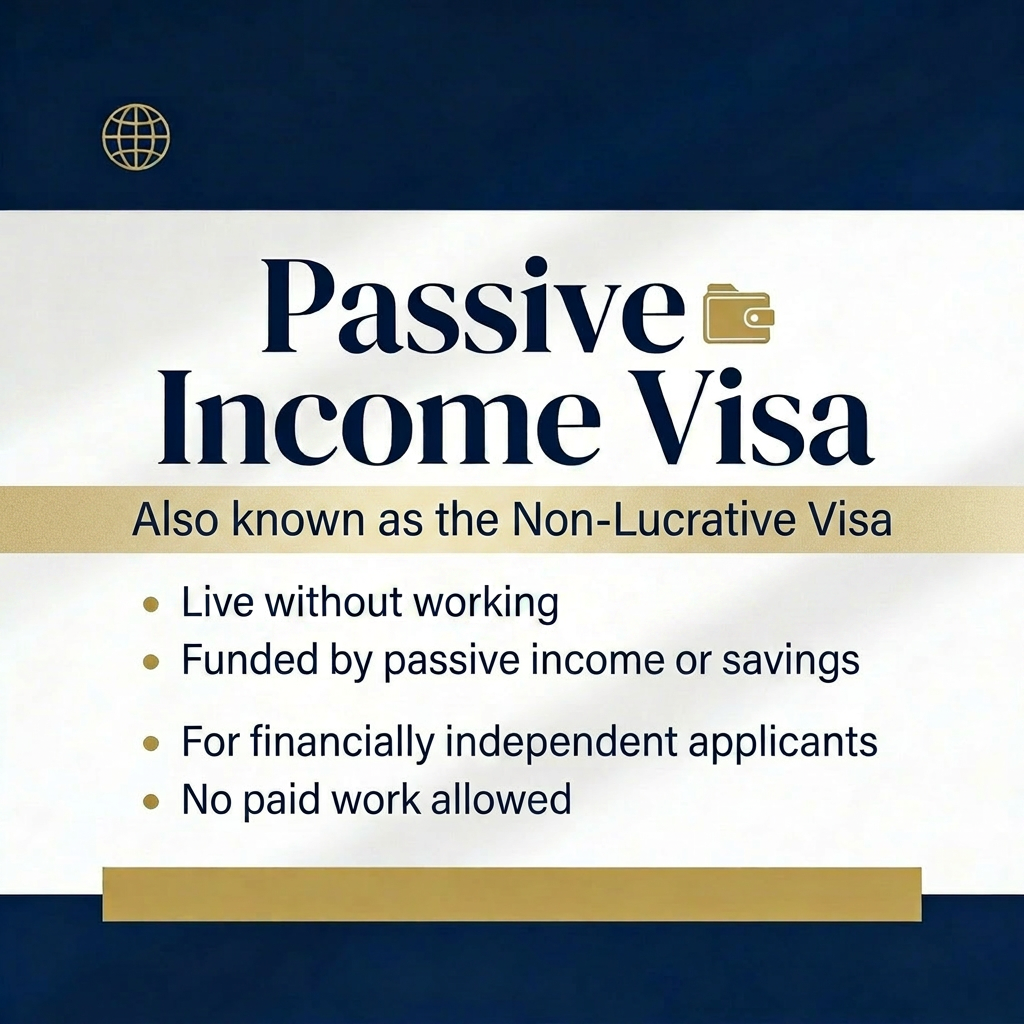
In 2026, the primary “showdown” between these categories is seen in the Portugal D7 (Passive Income) vs. the Spain NLV (Non-Lucrative), since Spain is the only country that uses the term of Non Lucrative Visa, while most countries in the world call it passive income visa.
Spain (ES) and Portugal (PT) are the most popular countries for these two program.
However, many countries globally offer the similar opportunity to reside and live under the same conditions as ES and PT.
- Both programs require you to have money before you arrive, but they offer completely different lifestyles once you’re on the ground.
- The Non-Lucrative Visa (NLV) and the Passive Income Visa (D7) have become the two most sought-after permits for anyone looking to immigrate to a new country and they are NOT exclusively reserved for High Networth Individuals (HNIs) , meaning anyone who meets the financial requirements are eligible to apply.
The Difference between Passive income visa and non lucrative visa are often small
The core difference lies in the word “Lucrative.”
- Non-Lucrative (Spain Model): “Non-lucrative” means you are legally prohibited from engaging in any “gainful” activity.
- This is a strict no-work visa. You are there to spend money, not make it.
- Passive Income (Portugal Model): While the entry requirement is based on passive funds, the residency itself is not non-lucrative.
- Once you are a resident, you are generally allowed to work, start a business, or freelance locally.
Most applicants who are looking to relocate via either of these options tend to be financially capable, and do not require employment in any of the country that offers these relocation opportunities.
While the term and program are largely popular in Europe, obtaining the same residency is possible in numerous countries.
Comparison of non lucrative visa and passive income visa
Let’s take a look at the two most well known residency options via non employment based income in Spain and Portugal.
| Feature | Non-Lucrative Visa (NLV) | Passive Income Visa (D7) |
| Example Country | Spain | Portugal |
| Work Rights | Strictly Prohibited. Even remote work for a US/UK company is technically a violation at most consulates. | Permitted. You apply with passive income, but once the card is in hand, you can work or open a company. |
| Income Type | Savings, Pensions, Dividends, Rents. | Pensions, Rents, Dividends, Royalties, Interest. |
| Annual Threshold | Higher (~€28,880 for 2026). | Lower (~€11,040 for 2026). |
| Path to Citizenship | 10 Years (standard). | 5 Years (standard). |
| Intent | Designed for retirees and the wealthy who want to live off savings. | Designed for retirees and investors who want to integrate into the economy. It is possible to seek employment in the country. |
Is non lucrative visa better or passive income visa better?

Which one fits your lifestyle?
1. The Case for the Non-Lucrative Visa (NLV)
Choose this residency type if you are truly retired or are financially well off with no intention of ever working again.
- The Advantage: It is often easier to prove “savings” (a large lump sum in a bank account) for the NLV than it is for the D7.
- The Catch: If you get bored after two years and want to start a small local business, it is necessary to switch your visa to a different category in Spain.
2. The Case for the Passive Income Visa (D7)
Choose this option if you want maximum freedom.
- The Catch: Portugal is much stricter about the source of the income.
- The country want to see a recurring “flow” (like a monthly pension or rent) rather than just a big pile of cash in a savings account.
- The Advantage: You enter based on your rental income or dividends, but you have the option to work.
- This makes it a favorite for “early retirees” who might find it enticing to work later on.
Non Lucrative Visa and Passive income visa explained
The Legal Definition: Restricted vs. Flexible
The core difference lies in the word “Lucrative.”
The Non-Lucrative Visa (Spain NLV)
The NLV is a “non-working” residency. In the eyes of the Spanish government, you are a consumer, not a producer.
- The Restriction: You are strictly prohibited from carrying out any economic activity within Spain.
- This includes opening a local business or working for a Spanish employer.
- Working Remotely Under Non Lucrative Visa: Spanish consulates have tightened rules. If you tell them you plan to work remotely for a US or UK company, your NLV will be denied.
- They will instead direct you to the Digital Nomad Visa (D8).
The Passive Income Visa (Portugal D7)
The D7 is far more flexible. While you must qualify using passive income (money that comes in while you sleep), you are not restricted once you arrive.
- The Freedom: Once your residency card is issued, you are legally permitted to work, freelance, or start a Portuguese company.
- The Intent: Portugal uses this visa to attract stable individuals who might eventually contribute to the local economy.
The Path to Citizenship
If your goal is a secondary passport, the timeline difference is worth considering.
- Portugal D7: You are eligible for Permanent Residency and Citizenship after 5 years. Portugal also allows you to count the time your “temporary” permit was processing toward that 5-year goal.
- Spain NLV: You can get Permanent Residency after 5 years, but Citizenship takes 10 years in total for most nationalities.
- Note: Citizens of Latin American countries can fast-track Spanish citizenship in just 2 years.
Documentation: What You’ll Need for each residency application
Both visas require a set of basic files – Passport, Health Insurance, Criminal Background Check, but the financial evidence varies:
For the Non-Lucrative Visa of spain:
- Bank Certificates: Official document showing the average balance over the last year.
- Affidavit: A notarized statement promising you will not work while in Spain.
- Medical Certificate: A specific letter stating you don’t carry diseases defined by International Health Regulations.
For the Passive Income Visa of portugal:
- Proof of NIF: You must have a Portuguese tax number before applying.
- Portuguese Bank Account: You must prove you have already moved funds into a local Portuguese bank.
- Lease Agreement: Portugal often requires a 12-month registered lease before the visa is even approved.
2. Financial Requirements
The “Proof of Funds” is where most applications succeed or fail, as both Portugal and Spain have increased their thresholds for 2026 based on rising inflation and minimum wage adjustments.
| Requirement | Spain Non-Lucrative Residency Permit | Portugal Passive Income Residency Permit |
| Main Applicant | ~€2,400 / month (€28,800/year) | ~€920 / month (€11,040/year) |
| Dependent Spouse | + €600 / month | + €460 / month |
| Savings vs. Income | Prefers a large “Lump Sum” | Prefers recurring “Flow” |
is digital nomad residency permit better or passive income residency better?
In 2026, many countries (including Spain and Portugal) have launched Digital Nomad Visas to separate “active” remote workers from “passive” earners.
- If you tell a Spanish consulate you want an NLV so you can work for an overseas company while you live in Spain, they will reject you and tell you to apply for the Digital Nomad Visa.
- If you tell a Portuguese consulate you want a D7 (Passive Income Visa) but your income is actually just your remote salary, they will redirect you to the D8 (Digital Nomad).
Basic points to keep in mind when which country is better for residency and relocation.
- Passive Income Visa = You are eligible if your qualifying income stream is passive, meaning you do not actively work for it, but you can work later.
- Non-Lucrative Visa = You qualify with passive money/savings, and you must never work.
While Portugal’s monthly requirement is lower, their consulates are much stricter about the source.
- Portuguese Consulate and Embassies want to see rents, dividends, or pensions that is received monthly into the bank account.
Spain is often happy to see a single bank account with the entire eligible amount already in the account
frequently asked questions: non lucrative visa better or passive income visa
Q: Can I manage my offshore company on an NLV?
A: Legally, no. Spain views “management” as work. If you are an active director, the NLV is a risk.
Q: Does rental income count for both?
A: Yes. Rental income from property you own is the “Gold Standard” for both the D7 and the NLV.
Q: Which is faster to get?
A: Currently, Spanish NLV applications are processed in 4–8 weeks. Portugal D7 applications are taking 4–6 months due to high demand and the reorganization of AIMA (formerly SEF).
Q: I apply for the wrong residency program and was rejected, will that affect my chances able to obtain the correct residency permit?
A: No, if you applied for the “wrong” which led to rejection (perhaps due to qualification requirements) and are willing to apply to the correct one, is positive in the eyes of the country.
- Being rejected for a residency program in Europe is different then the inability to obtain Schengen visa due to your background.
- In order to apply for the Non Lucrative Visa or Passive Income Visa successfully, the applicant must be eligible to or have previously held a Schengen visa, as this means the background of the applicant is accepted by country and European Union.
How BUH consulting can assist
In addition to Portugal and Spain, BUH Consulting’s global residency team will work with you to understand your requirements, financial situation, eligibility criteria and suggest the most suitable country that can meet your short and long term goals.
Contact information
For a tailored solution, contact us to discuss about your requirements.
Email: – sam@buh-consulting.com
Phone: +971585086656
Whatsapp: +971585086656
Telegram: BUHConsultingAE