
understand the difference between worldwide income tax and territorial tax
Worldwide Income vs. Territorial Taxation: The Entrepreneur’s Guide to Tax Residency in 2026
For the modern “Digital Nomad” founder or the established business consultant, the difference between worldwide income taxation and source-based (territorial) taxation is often the difference between a 40% tax bill and a 0% tax bill.
For the international entrepreneur, business consultant, or high-net-worth individual (HNWI), the concept of “home” is no longer just a lifestyle choice—it is a critical financial variable. As global transparency measures like the Common Reporting Standard (CRS) become more sophisticated in 2026, the era of “gray area” tax planning is over.
Success now depends on a precise understanding of two competing philosophies: Worldwide Income Taxation and Territorial Taxation.
Many jurisdictions are tightening their definitions of “tax resident.” Understanding these mechanics is essential for anyone managing offshore banking or international company formations.
1. What is Worldwide Income Taxation?
Most Western nations (and nearly all EU countries) operate on a Worldwide Income basis. Under this system, if you are deemed a tax resident, the government claims a right to tax every dollar you earn, regardless of where the work was performed or where the bank account or person is located.
- The 183-Day Myth: Many believe simply staying under 183 days makes them “tax-free.” In 2026, “Center of Life” tests are more common—authorities in certain countries look at where your family lives, where your business is managed, and even where your gym membership is.
- If you are a tax resident in these jurisdictions, the government views your global wealth as a single taxable pool.
- Double Taxation Risks: While Double Taxation Agreements (DTAs) exist, they often only offer credits for tax already paid, rather than a full exemption.
- In order to be deemed tax resident of a particular country and claim Double Tax Treaties (Also known as Double Tax Avoidance – DTA), it is necessary to proof in the country where the intention is to claim tax resident status:
- Permanent Accommodation: A home available for your use, even if rented.
- Economic Ties: A local business, a local director seat, or your primary bank accounts.
- Social Ties: Family residency, school registrations for children, or professional licenses.
- In order to be deemed tax resident of a particular country and claim Double Tax Treaties (Also known as Double Tax Avoidance – DTA), it is necessary to proof in the country where the intention is to claim tax resident status:
The Financial Impact of Worldwide Income Tax: If you earn $500,000 from a company registered in a tax-free jurisdiction such as Dubai, while being a tax resident of a country that taxes on worldwide income (like Germany), you would be liable in personal income tax, regardless of where the money was earned.
2. The “No Worldwide Income” Alternative: Territorial Taxation
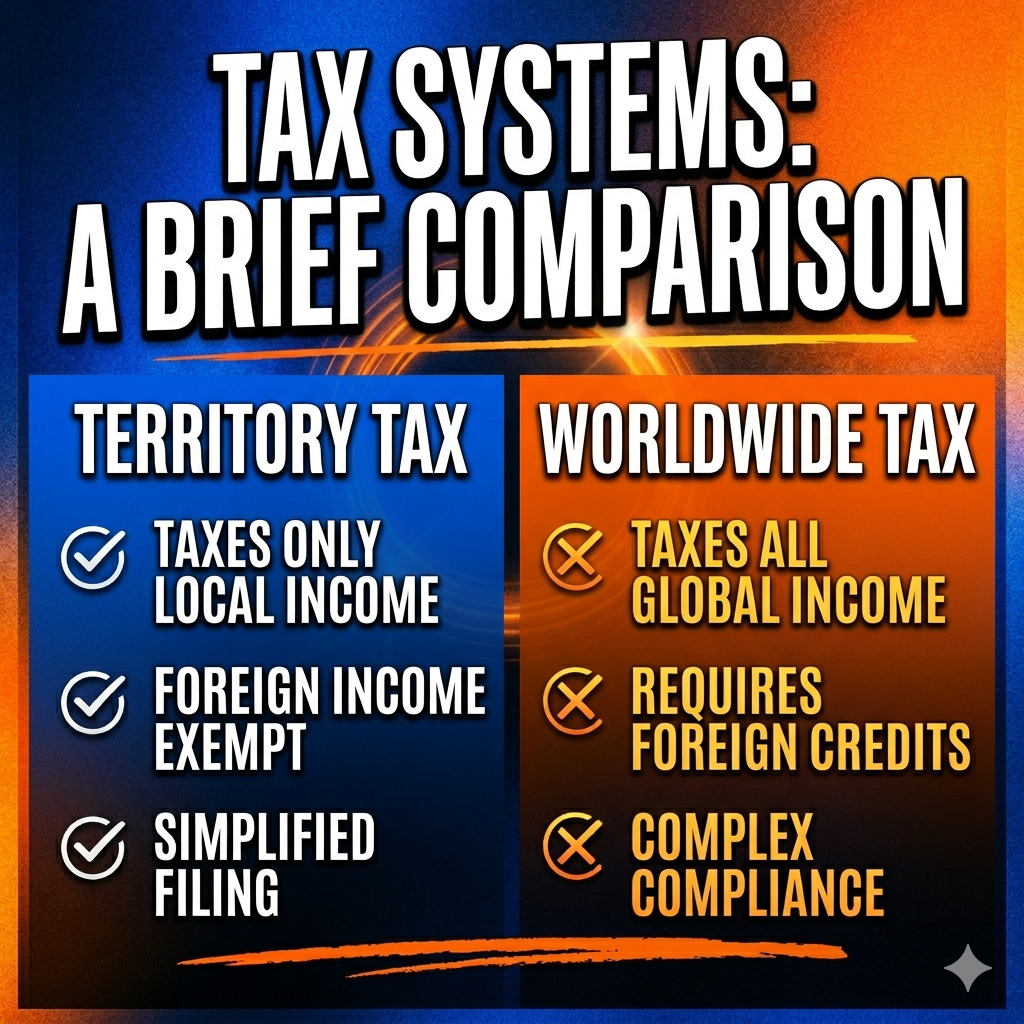
A Territorial Tax System only taxes income generated within that country’s borders.
- For an international business owner, this is the “Holy Grail” of tax planning.
If you are a tax resident in a territorial country but your clients and businesses are located in the UAE, USA, or Singapore, your personal tax liability on that foreign income is effectively zero.
This territory system draws a hard line at the border: income earned inside the country is taxed; income earned outside is not.
3. Best Tax Strategies for 2026
If you are moving your “Center of Life” to a tax-efficient jurisdiction like Dubai, consider these three pillars:
A. The “Non-Dom” Status
Shortform for Non Domicile or Non Domiciliation, countries like Cyprus, Malta, and the UK (under specific 2026 transitional rules) allow for “Non-Domiciled” status, meaning you are a resident, but you only pay tax on income brought into the country and money kept in offshore corporate accounts remains untaxed.
B. Corporate Management & Control
Even if you live in a tax-free country, if you manage a “Worldwide Income” company (e.g., a UK LTD) from your laptop in Dubai, that company could be deemed a tax resident of the UK. Always ensure your Company Formation matches your Personal Residency.
C. Legal Compliance & Reporting
In the era of CRS (Common Reporting Standard) and FATCA, “hiding” income is no longer a strategy. The only path to 0% tax is a legal change of residency to a jurisdiction that does not tax worldwide income.
Some countries offer a middle ground: the Remittance Basis of Taxation.
This is a specific legal status where you are a tax resident (obtained by residing in a country for more than 183 days) but are only taxed on foreign income that you physically “remit” (transfer) into your local bank account in the country of residence.
- Malta & Cyprus: These Mediterranean hubs offer “Non-Domiciled” statuses. If you keep your international earnings in an offshore account and only transfer what you need for living expenses, the amount that you DO NOT TRANSFER remains untaxed.
- Thailand (LTR Visa): Under the 2026 updates to the Long-Term Resident visa, foreign-sourced income is often exempt if certain conditions regarding the timing of the transfer are met.
4. Avoiding the “Exit Tax” and Corporate Pitfalls
Before consider changing your residency location, you must account for two major hurdles:
- Exit Taxes: Countries like the US and several EU nations may “tax your way out,” charging a percentage of your unrealized capital gains the moment you relinquish residency.
- Controlled Foreign Corporation (CFC) Rules: Even if you live in Dubai, if your company is registered in a worldwide income country, that country may still claim the right to tax the company’s profits, this is known as CFC rules.
- Proper international company formation must happen in tandem with your personal move.
5. Checklist for 2026 Tax Migration
- Verify DTA Status: Ensure your new home has a Double Taxation Agreement with your home country to prevent being taxed twice during the transition year.
- Establish Substance: Rent a physical apartment, get a local phone number, and open local bank accounts. “Paper residency” is no longer enough to satisfy modern audit standards.
- Audit Your “Center of Life”: If you want to claim 0% tax, you must prove your life has truly moved.
Top Countries with No Worldwide Income Tax for Residents (2026)
| Country | Tax Basis | Key Benefit for Expats |
| United Arab Emirates (UAE) Abu Dhabi, Al Ain, Ajman, Dubai, Fujairah, Ras Al Khaimah, Sharjah, Umm Al Quwain. | Territorial / Zero | No personal income tax on global or local earnings. A 9% Corporate Tax was introduced for domestic sourced profits within UAE exceeding $102,000, Personal Income Tax remains 0%. For a consultant managing international clients through a Free Zone entity, this means 0% tax on both the corporate and personal levels, provided the income is “foreign-sourced.” |
| Panama | Territorial | Foreign-sourced income is 100% exempt. Foreign-sourced income, including dividends from offshore companies and international consulting fees, is not subject to local tax. Its “Friendly Nations Visa” programs for nationals of commonwealth countries allows for easy residency, remains a top choice for those needing a Western-hemisphere base. |
| Paraguay | Territorial | Low threshold for residency; foreign income is untaxed. Paraguay is increasingly popular due to its simple 10-10-10 tax system (10% VAT, 10% Corporate, 10% Personal). Specifically, personal income tax only applies to locally sourced income. For a digital nomad or remote consultant, it effectively functions as a zero-tax haven. |
| Malaysia | Territorial | Foreign source income is generally exempt (with specific 2026 updates). |
| Singapore | Territorial | No tax on foreign-sourced dividends or income not “received” in SG. |
It is recommended to speak with a tax advisor both in their home country and country of interest, to align and confirm the necessary tax strategy.
What is theControlled Foreign Corporation Tax Lawand its implication worldwide Tax?
Certain countries tax their citizens, as well as residents who are not a national of the country but hold the tax resident status of the country, on their business income even if the company is established overseas (offshore), this is a concept known as Controlled Foreign Corporation (CFC).
- CFC rules are tax regulations that allow a government to tax the undistributed profits of a foreign company that is controlled by residents of the same country, regardless of their residency status or citizenship.
- Under these laws, a foreign entity may be treated as a local taxpayer for tax purposes, regardless of where it is legally registered
- For customers residing in countries that imposes CFC will not find opening a business overseas to be beneficial.
Understand which tax system is better between territory tax and worldwide Tax
| Feature | Worldwide Tax System | Territorial Tax System |
| Primary Principle | Taxation is based on Residency. | Taxation is based on Source. |
| Scope of Income | All income earned globally (domestic + foreign) is taxable even if it is not transferred into the country of residence. | Only income earned within the country of residence is taxable. |
| Foreign Income | Taxed, though can be offset by Foreign Tax Credits. | Generally tax-exempt or not reported. |
| Corporate Impact | Incentivizes keeping profits offshore to defer taxes. | Encourages the repatriation of foreign profits to the home country. |
| Individual Impact | Residents are taxed on global investments and remote work. | Residents are only taxed on local salaries or local business trade. |
| Examples | USA, UK, Canada, Australia, Germany. | UAE, Hong Kong, Singapore, Panama, Costa Rica. |
How To Structure For Tax Optimization
1. The “Rolling 12-Month” Trap: Why the Calendar Year is Often Irrelevant
Most entrepreneurs track their days from January to December, but in 2026, many aggressive jurisdictions (including Spain, Portugal, and Greece) have shifted to a “Rolling 12-Month” window.
- The Point: If you spend 100 days in a country at the end of 2025 and 90 days at the start of 2026, you haven’t hit the 183-day limit in either calendar year—but you have hit it within a 12-month period.
2. Permanent Establishment (PE) Risk: Managing Offshore from Your Laptop
A major 2026 trend is tax authorities across the world are looking at where a company is managed, not just where it is registered.
- The Point: If you live in a high-tax country (like the UK or France) but manage your “0% tax” UAE Free Zone company from your home office, the authorities can claim your company has a Permanent Establishment in their country. They can then tax your company’s global profits at local corporate rates.
3. The Digital Nomad “Nowhere” Myth
Many nomads believe that by spending less than 183 days in any country, they become “tax-free.” In the era of the OECD’s Pillar Two and increased CRS reporting, this is a dangerous myth.
- The Point: Banks and most crypto exchanges now require a Tax Identification Number (TIN) or a form of identification from your country of residence to keep accounts open.
- If you cannot prove tax residency in a low-tax or territorial jurisdiction (like Paraguay or the UAE), your “home” country may claim you by default under “Center of Vital Interests” rules.
- It is mandatory to obtain tax residency one country, in order to claim foreign tax status to your country of birth, which would otherwise want to tax you based on the local country’s tax system.
- If you cannot prove tax residency in a low-tax or territorial jurisdiction (like Paraguay or the UAE), your “home” country may claim you by default under “Center of Vital Interests” rules.
4. The 2026 “Lump-Sum” Solutions in Europe
For HNWIs who want to live in Europe but avoid worldwide income complexity, several countries have introduced “Lump-Sum” tax regimes.
Italy: The substitute tax for new residents on foreign income is now €200,000 (updated for 2026), covering all global earnings.
The Point: * Greece: Pay a flat €100,000 per year, and all your foreign-sourced income is tax-free.
Summary: How to Choose Your Residency To Optimize Your Tax Obligations
The European Hub: Cyprus or Andorra offer low-tax environments with high “livability” scores.
High-Touch Business: If you need physical infrastructure and a global hub, the UAE remains the gold standard for zero worldwide tax.
The Lean Nomad: Panama or Paraguay offer lower cost-of-living entry points with pure territorial systems.
International Tax Residency FAQ (2026 Edition)
Navigating the transition from worldwide taxation to a territorial or “non-dom” system is the most effective way for entrepreneurs to protect their wealth. Below are the most frequent questions we encounter regarding residency shifts in 2026.
1. What is the difference between a Tax Resident and a Tax Domicile?
- Tax Resident: Usually determined by physical presence (e.g., the 183-day rule). It dictates where you pay income tax for a specific year.
- Tax Domicile: A deeper legal connection, often linked to where you were born or where you intend to return permanently. In 2026, countries like the UK and Ireland use domicile to determine if they can tax your global estate and inheritances, even if you don’t live there.
2. Can I stay in a country for only X days and still be a tax resident?
Yes, but you must meet specific “Center of Vital Interest” criteria, the requirements vary country by country.
By meeting the requirements, it is possible to obtain a Tax Residency Certificate, which is necessary to claim Double Tax Treaties (DTT) in the country of residency and country of origin.
3. Does “Territorial Tax” mean I pay 0% tax on everything?
No. A territorial system only exempts foreign-sourced income.
- Exempt: Consulting fees from a US client paid to your Panama bank account.
- Taxable: Rent from an apartment you own in the country where you reside, or salary from a local job.
4. What are the “Lump-Sum” tax regimes in Europe?
Certain European countries offer an option to pay a one time annual amount to the government in and receive the country’s tax resident status, simplifying reporting requirements but often comes at a substantial cost.:
- Italy: In 2026, new residents can pay a flat €300,000 per year (increased from the previous €200k) to exempt all foreign-sourced income.
- Greece: Offers a €100,000 flat tax for 15 years, provided you invest at least €500,000 in the Greek economy.
5. What happens if I have no tax residency anywhere?
This is known as being a “Tax Nomad.” In 2026, this is increasingly difficult.
Under the Common Reporting Standard (CRS), banks are required to report your account data to your “country of residence.”
- If you don’t provide a Tax Identification Number (TIN) from a specific country, the bank may freeze your account or report you to your country of citizenship by default.
- It is important to note that not all countries are part of the CRS framework, which means they do not follow the Common Reporting Standard framework and therefore, have no obligation and often do not report you to your country of citizenship or residence
6. How does the “Center of Vital Interests” test work?
If you spend 5 months in a foreign tax-free such as the UAE but keep your family, your car, your house and your primary business in a high-tax country (like Canada), that country may argue you never truly left.
Countries look for “substance” or “physical nexus”—evidence that your life has physically and economically shifted, without which, they would tax you as if you are still residing in the country.
The below table shows the list most popular countries for those who are looking relocate and optimize their tax obligations.
- As countries become more competitive for foreign investment new options may become available after this article has been published.
- The below list should only be used by informational purpose and not tax or legal advice.
| Feature | UAE | Malta | Panama | Cyprus | Italy |
|---|---|---|---|---|---|
| Tax Basis | Zero / Territorial | Territorial | Territorial | Non-Dom (Remittance) | Lump-Sum |
| Min. Stay | 90–183 Days | 0 | 1–183 Days | 60 Days | 183 Days |
| Foreign Income Tax | 0% | 0% | 0% | 0% (unless remitted) | €300k Flat |
| Audit Risk | Low | Low | Low | Moderate | Very Low |
How BUH consulting can assist
Our team will work with you to understand your requirements, eligibility criteria and apply for your business and personal bank account with the most suitable banks and assign relationship managers from various that can onboard your account for your company.
Contact information
For a tailored solution, contact us to discuss about your requirements.
Email: – sam@buh-consulting.com
Phone: +971585086656
Whatsapp: +971585086656
Telegram: BUHConsultingAE